Wicks and Wick Sizing
Candle Wick Size Chart
Four published sizing charts, transcribed as they were printed and laid side by side, including the places where they disagree by two full sizes.
We have not burned these candles and we do not claim to have. Here is what we did instead. Links to Amazon earn us a commission at no extra cost to you — disclosure.

| # | Product | Best for | Price |
|---|---|---|---|
| 1 | 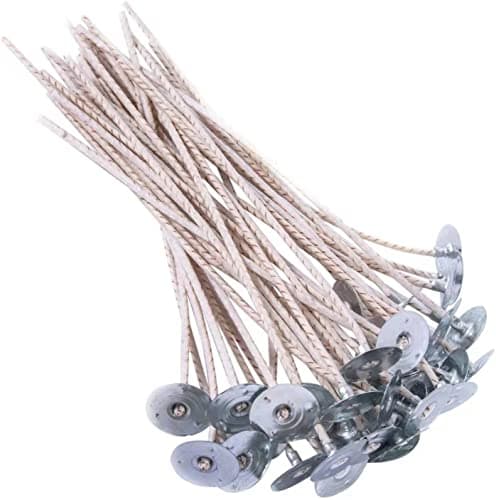 ECO 10 Pre-Waxed Wicks for Soy Candles, 100 pcsTop pickECO is the series whose charts are published for soy directly rather than adjusted from paraffin, which makes it the easiest series for a beginner to size correctly on the first try. | 3 to 3.25 inch soy containers, on the US charts | |
| 2 | 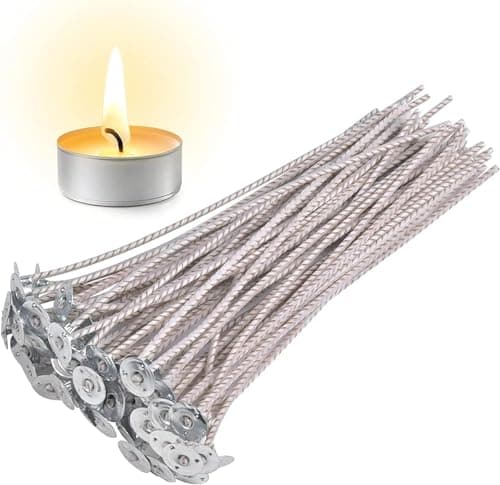 CD 12 Pre-Tabbed Candle Wicks for Soy Candles, 100 pcsCD 12 is the size the published soy charts point to for a standard 3-inch jar, which is the jar most beginner kits ship. Buying the series by size rather than by assortment is how you actually control a burn. | Jars around 2.5 to 3 inches across | |
| 3 | 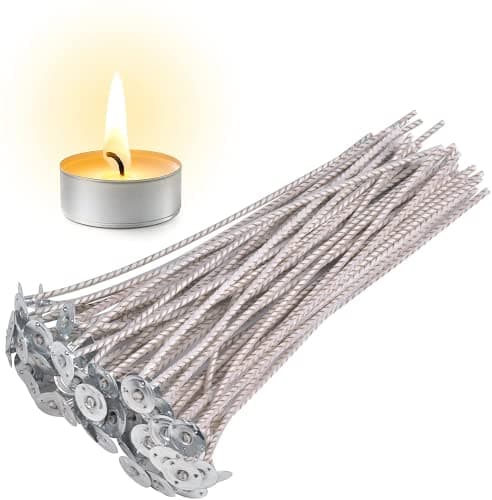 ECO 4 Pre-Waxed Wicks for Soy Candles, 100 pcsThe size for the 4-ounce tins that come in nearly every starter kit. Kits routinely ship one unnamed wick size for every container they include, and this is what those small tins actually wanted. | Small tins and 2 to 2.5 inch jars | |
| 4 | 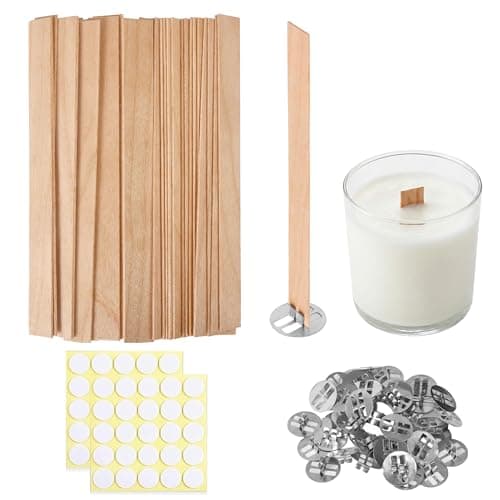 150 Piece Thickened Wooden Candle Wicks, 5.1 x 0.5 inchWooden wicks are bought for the sound, and they are the single hardest wick to size correctly in soy. The published charts disagree with each other by a full size on exactly this question. | The crackle, in a 2.5 to 3 inch jar |
Every candle supplier publishes a wick chart. Almost none of them publish anyone else's, so you end up trusting whichever shop you happened to buy from. We have transcribed four of them here and put them in one table, with the publisher on every row and the wax each chart was calibrated against stated up front.
This is original work in the only sense that matters: nothing here is averaged, interpolated, or smoothed to make a tidy table. Where a chart has a gap, the gap stays. Where two publishers give different answers for the same jar, you see both.
Find your starting wick
Measure the inside diameter of your container, not the outside, and not the capacity in ounces. A 10-ounce jar can be 2.5 inches across and tall, or 3.5 inches across and squat, and those need different wicks.
Starting wick finder
Every published answer for your container, with the publisher named on each.
ECO series
- ECO 8 — Lone Star Candle Supply
- ECO 8 — CandleScience
- ECO 8 — Tools for Makers
- ECO 14 — Wedo, metric chart (up to 80 mm)
CD series
- CD 12 — Tools for Makers
- CD-8 — Lone Star Candle Supply, published for base paraffin, so size up one to three
HTP series
- HTP-73 — Lone Star Candle Supply, published for base paraffin, so size up one to three
LX series
- LX-16 — Lone Star Candle Supply, published for base paraffin, so size up one to three
- LX 20 — Wedo, metric chart, published for paraffin
Zinc core series
- 51-32-18 — Lone Star Candle Supply, published for base paraffin, so size up one to three
Wooden
- Large — Lone Star Candle Supply
- 0.5 inch ribbon — Tools for Makers
This is a starting wick, not an answer. Fragrance load, dye and container shape all shift the result and none of them are in any published chart. Buy this size and the one above it, pour two identical candles, and burn both for four hours.
The full cross-manufacturer table
Every row below is exactly as its publisher printed it. Metric figures are converted at 25.4 mm to the inch and the original is shown alongside, so you can check the arithmetic.
| Diameter | Lone Star Candle Supplybasis: soy | CandleSciencebasis: soy | Tools for Makersbasis: soy | Wedo, metric chartbasis: soy |
|---|---|---|---|---|
| 1.5" | ECO 1 | ECO 1 | ECO 1-2 | ECO 0.5up to 50 mm |
| 2" | ECO 2 | ECO 2 | ECO 1-2 | ECO 0.75up to 53 mm |
| 2.25" | ECO 4 | ECO 4 | ECO 4 | ECO 2up to 60 mm |
| 2.5" | ECO 4 | ECO 4 | ECO 4 | ECO 4-6up to 65 mm |
| 2.75" | ECO 6 | ECO 6 | ECO 6 | ECO 8-10up to 70 mm |
| 3" | ECO 8 | ECO 8 | ECO 8 | ECO 14up to 80 mm |
| 3.25" | ECO 10 | ECO 10 | ECO 10 | ECO 1680 mm and above |
| 3.5" | ECO 12 | ECO 12 | ECO 12 | ECO 1680 mm and above |
| 3.75" | ECO 14 | ECO 14 | ECO 14 | ECO 1680 mm and above |
| 4" | no row | no row | ECO 16 | ECO 1680 mm and above |
Lone Star Candle Supply: Published as already accounting for soy, so no size-up instruction is attached.
CandleScience: Published as upper bounds only, as containers up to a diameter.
Tools for Makers: Carries a published instruction to increase one to two sizes for beeswax.
Wedo, metric chart: The wick maker's own metric chart. It is listed for soy and paraffin alike, which is why it reads more conservatively than the US soy-specific charts.
| Diameter | Tools for Makersbasis: soy | Lone Star Candle Supplybasis: base paraffin |
|---|---|---|
| 1.5" | CD 4-6 | CD-4 |
| 2" | CD 4-6 | CD-5 |
| 2.25" | CD 8 | CD-6 |
| 2.5" | CD 8 | CD-7 |
| 2.75" | CD 10 | CD-8 |
| 3" | CD 12 | CD-8 |
| 3.25" | CD 14 | CD-10 |
| 3.5" | CD 16 | CD-12 |
| 3.75" | CD 18 | CD-14 |
| 4" | CD 20-22 | CD-16 |
Tools for Makers: Published for soy, with an instruction to reduce one to two sizes for paraffin.
Lone Star Candle Supply: Base-paraffin figures. The publisher's instruction is to size up one to three for soy and for single-pour paraffin.
| Diameter | Lone Star Candle Supplybasis: base paraffin |
|---|---|
| 1.5" | no row |
| 2" | HTP-41 |
| 2.25" | HTP-41 |
| 2.5" | HTP-52 |
| 2.75" | HTP-62 |
| 3" | HTP-73 |
| 3.25" | HTP-83 |
| 3.5" | HTP-83 |
| 3.75" | HTP-104 |
| 4" | HTP-104 |
Lone Star Candle Supply: Base-paraffin figures with a published instruction to size up one to three for soy.
| Diameter | Lone Star Candle Supplybasis: base paraffin | Wedo, metric chartbasis: paraffin |
|---|---|---|
| 1.5" | LX-8 | LX 08up to 40 mm |
| 2" | LX-10 | LX 14up to 55 mm |
| 2.25" | LX-12 | LX 16up to 65 mm |
| 2.5" | LX-14 | LX 16up to 65 mm |
| 2.75" | LX-16 | LX 18up to 75 mm |
| 3" | LX-16 | LX 20up to 80 mm |
| 3.25" | LX-18 | LX 22-2680 mm and above |
| 3.5" | LX-20 | LX 22-2680 mm and above |
| 3.75" | LX-21 | LX 22-2680 mm and above |
| 4" | LX-22 | LX 22-2680 mm and above |
Lone Star Candle Supply: Base-paraffin figures with a published instruction to size up one to three for soy.
| Diameter | Lone Star Candle Supplybasis: base paraffin |
|---|---|
| 1.5" | no row |
| 2" | 44-24-18 |
| 2.25" | 44-24-18 |
| 2.5" | no row |
| 2.75" | no row |
| 3" | 51-32-18 |
| 3.25" | 51-32-18 |
| 3.5" | 51-32-18 |
| 3.75" | 60-44-18 |
| 4" | 60-44-18 |
Lone Star Candle Supply: Published as not recommended for soy. Single-pour paraffin usually needs one or two sizes up. The chart has no row between 2.25 and 3 inches, and that gap is reproduced here rather than filled in.
Where the charts disagree, and why
The disagreements are not errors. They come from three specific, documented differences in how the charts were built.
1. Paraffin-based charts versus soy-based charts
Lone Star publishes its CD, HTP, LX and zinc charts against base paraffin, with an explicit instruction to size up one to three for soy. Tools for Makers publishes its CD chart against soy directly. So Lone Star's CD-10 row (3.0 to 3.25 inches) and Tools for Makers' CD 16 row (3.0 to 3.5 inches) are describing the same jar with different waxes in it. Apply the size-up instruction to Lone Star's CD-10 and you land between CD-12 and CD-16, which is exactly where the soy chart already is.
2. The manufacturer's own chart is more conservative than the shops' charts
This is the most useful finding in the whole table. Wedo's ECO chart, published in millimeters, caps ECO 8 to 10 at 70 mm, which is 2.76 inches. The three US supplier charts all put ECO 10 at 3.0 to 3.25 inches. For a 3-inch jar that is a two-size gap: ECO 10 from the US shops, ECO 14 from the wick maker.
The likely reason is stated in Wedo's own chart notes: their ECO listing covers soy and paraffin together. A chart that has to be safe in both waxes has to be sized for the more demanding one. The US charts are soy-specific and can be less cautious.
If you are not working in soy, the wax-specific pages are more direct: the paraffin chart gives the published rows with no adjustment applied, and the beeswax chart shows what the published size-up instruction actually produces.
3. Wooden wicks are the least settled category
The two published wooden wick charts disagree about soy by a full size. Lone Star caps a medium wooden wick at 2.25 inches in soy and allows 3.0 inches in paraffin. Tools for Makers puts a 0.5-inch ribbon at 2.5 to 3 inches regardless of wax, with a note that pure soy usually needs a booster or a double-ply construction.
| Size | Soy, up to | Paraffin, up to |
|---|---|---|
| Small | not recommended | 2.25" |
| Medium | 2.25" | 3" |
| Large | 3.25" | 3.25" |
| X-Large | 3.5" | 3.75" |
Small wooden wicks are published as not recommended for soy at any diameter.
| Size | Soy, up to | Paraffin, up to |
|---|---|---|
| 0.375 inch ribbon | 2.5" | 2.5" |
| 0.5 inch ribbon | 3" | 3" |
| 0.625 inch ribbon | 3.5" | 3.5" |
| 0.75 inch ribbon | 4" | 4" |
Published with a caution that pure soy usually needs a booster or a double-ply wick.
Reading both together: a single-ply wooden wick in pure soy is marginal above about 2.5 inches, and the double-ply booster wicks exist precisely because of that. If you want the crackle in a 3-inch soy jar, buy the booster construction.
How to read a range
Some charts print a range (2.5 to 3 inches), some print only an upper bound (containers up to 3 inches). They mean the same thing in practice: take the smallest wick whose upper bound reaches your diameter. Ranges overlap deliberately, because the correct wick inside an overlap depends on your fragrance load and your wax, which no chart knows.
Top pick · 3 to 3.25 inch soy containers, on the US charts
ECO 10 Pre-Waxed Wicks for Soy Candles, 100 pcs
ECO series
ECO is the series whose charts are published for soy directly rather than adjusted from paraffin, which makes it the easiest series for a beginner to size correctly on the first try.
#ad · how this is funded · price as of October 17, 2026
Published specifications
- Series
- ECO, flat coreless cotton with paper filamentsSource: Amazon product listing, read 2026-09-02
- Quantity
- 100 piecesSource: Amazon product listing, read 2026-09-02
- Length
- 6 inches, pre-waxed with tabSource: Amazon product listing, read 2026-09-02
- Published range (soy)
- 3.0 to 3.25 inch containersSource: Lone Star Candle Supply ECO soy chart
- Alternative published range
- up to 2.76 inchesSource: Wedo metric ECO chart
What that means
The two published ranges above disagree by nearly half an inch for the same wick, and both are printed by people who sell it. That is not an error on anyone's part; the US charts are soy-adjusted and the Wedo chart covers soy and paraffin together.
Practically: if you are in a 3-inch soy jar and you use the US charts, ECO 10 is the starting wick. If you use Wedo's, you want ECO 14 in the same jar. Test both.
The paper filaments in an ECO wick make it curl and self-trim, in the same way CD does. Both are coreless, so there is no metal or zinc in the flame.
Good
- Charts published for soy directly, not adjusted from paraffin
- Coreless and self-trimming
- The series most commonly stocked with soy kits
Less good
- Published guidance varies by up to two sizes between suppliers
- Needs a size up again in beeswax
Skip this one if
You are burning paraffin. The LX and zinc charts are the ones written for it, and an ECO sized for soy will be too large.
Pick 2 · Jars around 2.5 to 3 inches across
CD 12 Pre-Tabbed Candle Wicks for Soy Candles, 100 pcs
CD series
CD 12 is the size the published soy charts point to for a standard 3-inch jar, which is the jar most beginner kits ship. Buying the series by size rather than by assortment is how you actually control a burn.
#ad · how this is funded · price as of October 17, 2026
Published specifications
- Series
- CD, cotton and paper flat braidSource: Amazon product listing, read 2026-09-02
- Quantity
- 100 piecesSource: Amazon product listing, read 2026-09-02
- Length
- 6 inches, pre-tabbedSource: Amazon product listing, read 2026-09-02
- Published range (soy)
- 2.5 to 3 inch containersSource: Tools for Makers CD soy chart
What that means
CD wicks curl as they burn, which trims the tip and reduces the mushroom of carbon that builds on a straight wick. That self-trimming behavior is the whole reason the series exists.
The published charts disagree on CD for soy by up to two sizes, because Lone Star prints CD against base paraffin and tells you to size up one to three for soy. Our chart shows both readings side by side.
Good
- One size, 100 of them, so you can run a proper burn test
- Self-trimming curl reduces mushrooming
- Pre-tabbed, so no assembly
Less good
- Wrong size for a 4-inch jar and wrong size for a votive
- CD in beeswax needs a different size again
Skip this one if
You do not yet know your container diameter. Measure the inside of the jar first, then buy the size the chart gives you.
Pick 3 · Small tins and 2 to 2.5 inch jars
ECO 4 Pre-Waxed Wicks for Soy Candles, 100 pcs
ECO series
The size for the 4-ounce tins that come in nearly every starter kit. Kits routinely ship one unnamed wick size for every container they include, and this is what those small tins actually wanted.
#ad · how this is funded · price as of October 17, 2026
Published specifications
- Series
- ECO, flat coreless cotton with paper filamentsSource: Amazon product listing, read 2026-09-02
- Quantity
- 100 piecesSource: Amazon product listing, read 2026-09-02
- Published range (soy)
- 2.0 to 2.5 inch containersSource: Lone Star Candle Supply ECO soy chart
What that means
A standard 4-ounce candle tin measures a little under 2.5 inches across the inside. That puts it squarely in the ECO 4 row on both US charts.
Small containers are where an oversized wick shows up fastest: the flame is large relative to the vessel, the glass gets hot, and the candle burns down in an evening.
Good
- Correct size for the ubiquitous 4-ounce tin
- Coreless
- 100 in a pack, enough for real testing
Less good
- Far too small for a standard 3-inch jar
- One size only
Skip this one if
Your containers are 3 inches or wider. Start at ECO 10 instead.
Pick 4 · The crackle, in a 2.5 to 3 inch jar
150 Piece Thickened Wooden Candle Wicks, 5.1 x 0.5 inch
Generic (Amazon listing)
Wooden wicks are bought for the sound, and they are the single hardest wick to size correctly in soy. The published charts disagree with each other by a full size on exactly this question.
#ad · how this is funded · price as of October 17, 2026
Published specifications
- Dimensions
- 5.1 x 0.5 x 0.06 inchesSource: Amazon product listing, read 2026-09-02
- Quantity
- 150 piecesSource: Amazon product listing, read 2026-09-02
- Published range, 0.5 inch ribbon
- 2.5 to 3 inch containers, soy or paraffinSource: Tools for Makers wooden wick chart
- Conflicting published guidance
- Medium wooden wick rated to 2.25 inches in soy, 3.0 inches in paraffinSource: Lone Star Candle Supply wooden wick chart
What that means
Those two published figures cannot both be right for the same jar. One chart puts a half-inch wooden ribbon at up to 3 inches in soy; the other caps a comparable medium wick at 2.25 inches in soy and only allows 3 inches in paraffin.
The practical read: in pure soy, a wooden wick is likely to struggle in anything wider than about 2.5 inches without a booster. Buy the wick, but expect a burn test, and expect to need a second one.
Wooden wicks are also the wick most sensitive to fragrance load. A heavy oil load smothers them in a way it does not smother cotton.
Good
- The crackle, which no cotton wick produces
- 150 in a pack, which you will need for testing
- Dimensions published exactly
Less good
- Published sizing guidance conflicts by a full size in soy
- Struggles at high fragrance loads
- Needs a dedicated clip, not a standard wick tab
Skip this one if
You want a candle that works on the first pour. Wooden wicks in soy are the most test-hungry combination in this whole category.
The limit of this page
This chart gets you to a starting wick. It cannot finish the job. Fragrance load, dye, container shape and the specific wax blend all shift the result, and none of them appear in any published chart. You still have to burn one and watch the pool, and we cannot do that part for you.
Wick burn testing is the four-hour procedure that settles it, and it is genuinely the only thing that does. If your candle already exists and is misbehaving, wick too big or too small tells you which direction to move. The charts above stop at about 4 inches of diameter; how many wicks does a candle need covers what to do with a container wider than that.
How these picks were made. Published specifications compiled from the sources listed below, the arithmetic shown on the page, and live Amazon prices. No product here has been burned by us. Read the method.
Common questions
What wick size for a 3 inch candle in soy wax?
ECO 10 or CD 14 to CD 16, on the three US charts. Wedo's own metric chart puts the same jar at ECO 14, a two-size difference. Start with ECO 10 and burn-test; if the melt pool does not reach the glass in four hours, move up.
What wick for a 2.5 inch candle?
ECO 4 to ECO 6 in soy (Lone Star's ECO 4 row runs 2.0 to 2.5 inches and ECO 6 starts at 2.5), or CD 8 to CD 10. In paraffin, LX-14 or HTP-52.
Is a wick chart the same for beeswax?
No. Tools for Makers publishes an explicit instruction to increase one to two ECO sizes for beeswax over soy. Beeswax has a much higher melt point, so the same wick delivers less liquid wax.
How do I measure my container diameter?
Measure across the inside of the container at the level the wax will reach, in inches. Do not use the outside diameter and do not use the capacity in fluid ounces; neither tells the wick anything useful.
Why does the same wick appear at different diameters on different charts?
Because the charts are calibrated against different waxes. A CD chart written for base paraffin and one written for soy will give different sizes for the same jar. Every row in our table names its basis so you can tell which applies.
What if my diameter falls between two rows?
Take the smaller wick and burn-test it. Undersized gives you tunneling, which is diagnosable and reversible on the next pour. Oversized gives you soot and a hot container, which is a safety problem.
Sources
- Lone Star Candle Supply - Guide to Wicking (ECO, CD, HTP, LX, zinc and wooden wick charts)
- CandleScience - How to Properly Wick Container Candles
- Tools for Makers - Candle Wick Size Chart for Soy, Paraffin and Beeswax
- Wedo ECO, LX and TCR wick size charts, published in metric by a UK supplier
- Northstar 3C - ECO wick series information
- Cal Candle Supply - Golden Wax 464 published instructions (heat, fragrance and pour temperatures)
Read next
Wicks and Wick Sizing
Four published sizing charts cross-referenced into one table, plus the wick picks that match the containers most kits ship.
How to Choose a Wick Size
The five-step method for choosing a wick: measure the diameter, read the chart for your wax, adjust for fragrance load, buy two sizes, burn test.

Wick Burn Testing
The full burn test procedure: setup, what to record hour by hour, what a correct melt pool looks like, and how to read each failure.
Best Candle Wicks for Soy Candles
Wick picks matched to the container sizes most kits ship, with the published chart range printed on every one.
Top pick
ECO 10 Pre-Waxed Wicks for Soy Candles, 100 pcs
Soy Wax for Candle Making
Soy wax explained: what it is, the published working temperatures for the reference blends, and how 444, 464 and pillar soy differ.
What Size Candle Jar
Choosing a jar size by diameter rather than capacity, with the wax, wick and burn-time consequences of each common size.