Wicks and Wick Sizing
How to Choose a Wick Size
Five steps, in order. Four of them take a minute; the fifth takes four hours and is the one that actually decides it.
We have not burned these candles and we do not claim to have. Here is what we did instead. Links to Amazon earn us a commission at no extra cost to you — disclosure.
| # | Product | Best for | Price |
|---|---|---|---|
| 1 | 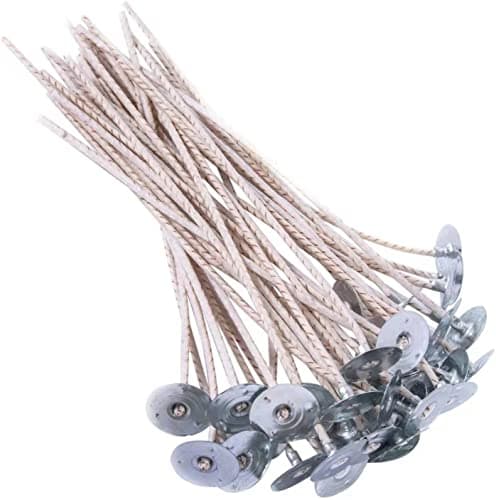 ECO 10 Pre-Waxed Wicks for Soy Candles, 100 pcsTop pickECO is the series whose charts are published for soy directly rather than adjusted from paraffin, which makes it the easiest series for a beginner to size correctly on the first try. | 3 to 3.25 inch soy containers, on the US charts | |
| 2 | 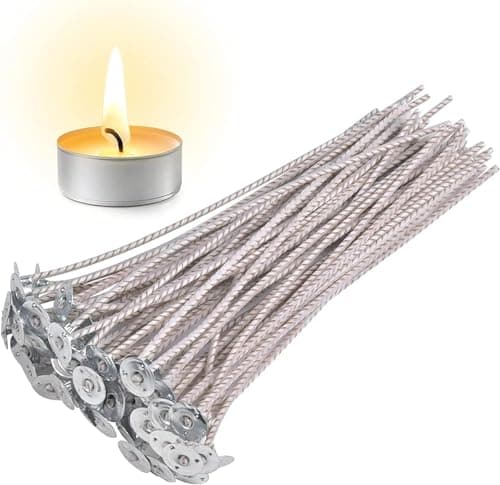 CD 12 Pre-Tabbed Candle Wicks for Soy Candles, 100 pcsCD 12 is the size the published soy charts point to for a standard 3-inch jar, which is the jar most beginner kits ship. Buying the series by size rather than by assortment is how you actually control a burn. | Jars around 2.5 to 3 inches across | |
| 3 | 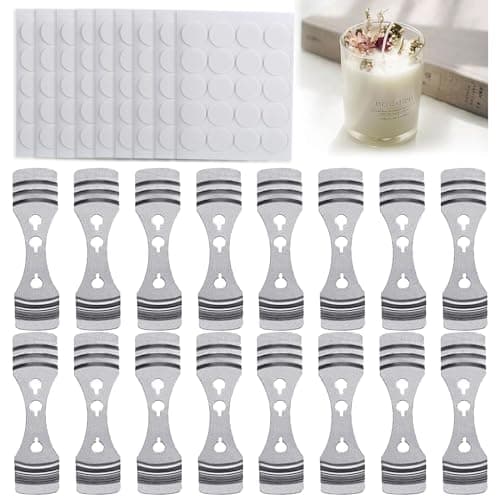 DINGPAI 20 Candle Wick Holders and 180 Wick StickersThe cheapest fix for the most common cosmetic failure in a first batch. A wick that drifts off-center while the wax sets gives you a candle that burns down one side of the jar and stops. | Keeping the wick where you put it |
There is a method here, and following it in order matters, because each step narrows the answer and skipping one leaves you guessing about something you could have known.
Step 1: measure the inside diameter
In inches, across the inside of the container, at the height the wax will sit. Not the outside of the glass, not the capacity in ounces, not the diameter of the lid.
This matters more than it sounds because capacity and diameter are not related in any fixed way. A tall narrow 10-ounce jar and a squat wide 10-ounce jar are different candles that need different wicks. Almost no jar listing publishes an internal diameter, so you are going to be doing this with a ruler regardless.
Step 2: read the chart for your wax family
Go to the wick size chart and find your diameter. Read the row for the series you are buying, and check the basis column: if the chart says base paraffin and you are pouring soy, you have another step. If it says soy and you are pouring soy, you are done reading.
| Your wax | Use this chart basis | Adjustment |
|---|---|---|
| Soy container blend | The soy-basis ECO or CD chart | None |
| Soy, using a paraffin-basis chart | Base paraffin | Size up one to three, per the publisher's note |
| Paraffin | Base paraffin (LX, HTP, zinc) | None |
| Beeswax | Soy ECO chart | Size up one to two, per Tools for Makers |
| Coconut soy blend | Soy ECO chart | Consider one size down; lower melt point delivers wax faster |
Step 3: adjust for fragrance load
Fragrance oil thins the wax and partially clogs the wick braid. A candle at 10 percent load behaves differently from the same candle at 6 percent, and the charts do not know which one you are making.
The usual practice is to size up when running at the top of your wax's published maximum. Golden Wax 464 publishes a 10 percent maximum; if you are at that ceiling, take the next wick up as your test candidate as well. See how much fragrance oil per pound for the arithmetic.
Step 4: buy two sizes
This is where most people go wrong, and it is the cheapest step to get right. Buy the chart size and the size above it. A hundred-count pack costs very little and you need to compare in order to judge.
- Pour two identical candles: same wax, same fragrance, same load, same jar.
- Put one wick size in each.
- Label them. You will not remember.
- Cure them the same length of time, side by side.
Step 5: burn test
Four hours, side by side, in a draft-free room. What you are looking for is a full melt pool that reaches the container wall and is roughly a quarter inch deep, with a flame around an inch to an inch and a half, no soot on the glass, and a container you can pick up.
The complete procedure, including what to record and what each failure mode means, is on wick burn testing. It is the only step that actually settles the question, and no amount of chart reading substitutes for it.
Top pick · 3 to 3.25 inch soy containers, on the US charts
ECO 10 Pre-Waxed Wicks for Soy Candles, 100 pcs
ECO series
ECO is the series whose charts are published for soy directly rather than adjusted from paraffin, which makes it the easiest series for a beginner to size correctly on the first try.
#ad · how this is funded · price as of October 17, 2026
Published specifications
- Series
- ECO, flat coreless cotton with paper filamentsSource: Amazon product listing, read 2026-09-02
- Quantity
- 100 piecesSource: Amazon product listing, read 2026-09-02
- Length
- 6 inches, pre-waxed with tabSource: Amazon product listing, read 2026-09-02
- Published range (soy)
- 3.0 to 3.25 inch containersSource: Lone Star Candle Supply ECO soy chart
- Alternative published range
- up to 2.76 inchesSource: Wedo metric ECO chart
What that means
The two published ranges above disagree by nearly half an inch for the same wick, and both are printed by people who sell it. That is not an error on anyone's part; the US charts are soy-adjusted and the Wedo chart covers soy and paraffin together.
Practically: if you are in a 3-inch soy jar and you use the US charts, ECO 10 is the starting wick. If you use Wedo's, you want ECO 14 in the same jar. Test both.
The paper filaments in an ECO wick make it curl and self-trim, in the same way CD does. Both are coreless, so there is no metal or zinc in the flame.
Good
- Charts published for soy directly, not adjusted from paraffin
- Coreless and self-trimming
- The series most commonly stocked with soy kits
Less good
- Published guidance varies by up to two sizes between suppliers
- Needs a size up again in beeswax
Skip this one if
You are burning paraffin. The LX and zinc charts are the ones written for it, and an ECO sized for soy will be too large.
Pick 2 · Jars around 2.5 to 3 inches across
CD 12 Pre-Tabbed Candle Wicks for Soy Candles, 100 pcs
CD series
CD 12 is the size the published soy charts point to for a standard 3-inch jar, which is the jar most beginner kits ship. Buying the series by size rather than by assortment is how you actually control a burn.
#ad · how this is funded · price as of October 17, 2026
Published specifications
- Series
- CD, cotton and paper flat braidSource: Amazon product listing, read 2026-09-02
- Quantity
- 100 piecesSource: Amazon product listing, read 2026-09-02
- Length
- 6 inches, pre-tabbedSource: Amazon product listing, read 2026-09-02
- Published range (soy)
- 2.5 to 3 inch containersSource: Tools for Makers CD soy chart
What that means
CD wicks curl as they burn, which trims the tip and reduces the mushroom of carbon that builds on a straight wick. That self-trimming behavior is the whole reason the series exists.
The published charts disagree on CD for soy by up to two sizes, because Lone Star prints CD against base paraffin and tells you to size up one to three for soy. Our chart shows both readings side by side.
Good
- One size, 100 of them, so you can run a proper burn test
- Self-trimming curl reduces mushrooming
- Pre-tabbed, so no assembly
Less good
- Wrong size for a 4-inch jar and wrong size for a votive
- CD in beeswax needs a different size again
Skip this one if
You do not yet know your container diameter. Measure the inside of the jar first, then buy the size the chart gives you.
Pick 3 · Keeping the wick where you put it
DINGPAI 20 Candle Wick Holders and 180 Wick Stickers
DINGPAI
The cheapest fix for the most common cosmetic failure in a first batch. A wick that drifts off-center while the wax sets gives you a candle that burns down one side of the jar and stops.
#ad · how this is funded · price as of October 17, 2026
Published specifications
- Contents
- 20 stainless steel wick centering devices, 180 wick stickersSource: Amazon product listing, read 2026-09-02
- Holder size
- 3.9 in long, 0.98 in wideSource: Amazon Creators API item data, read 2026-09-18
- Sticker size
- 0.75 in diameter, 1 mm thick, double-sided foamSource: Amazon Creators API item data, read 2026-09-18
- Material
- Stainless steelSource: Amazon product listing, read 2026-09-02
What that means
Kits usually include a handful of stickers and no holders at all. The holder is the part that keeps the wick vertical and centered for the twenty minutes it takes the surface to skin over.
Twenty holders means you can pour twenty candles in a session rather than pouring two and waiting.
Good
- Solves off-center wicks completely
- 180 stickers is a real supply
- Reusable metal, not a consumable
Less good
- Not needed if your kit already included holders
- Only fits jars within the holders' span
Skip this one if
Your kit shipped centering devices already. These do exactly the same job.
A worked example
When the answer is two wicks
Past about 4 inches of diameter, no single wick reaches the wall without running the center far too hot. That is the point at which you move to two wicks, spaced so their pools merge, each sized for roughly half the diameter. Below 4 inches, two wicks make one overheated pool rather than two well-behaved ones. Past about 4 inches the question stops being which wick and starts being how many, which is covered on how many wicks does a candle need.
How these picks were made. Published specifications compiled from the sources listed below, the arithmetic shown on the page, and live Amazon prices. No product here has been burned by us. Read the method.
Common questions
How do I know what size wick to use?
Measure the inside diameter of your container, look it up on a chart written for your wax family, adjust up if your fragrance load is at the wax's published maximum, then burn-test the chart size against the size above it.
Does the height of the candle affect wick size?
No. Wick size is set by diameter, because diameter is what the melt pool has to cross. Height affects burn time, not wick size.
Should I size up for fragrance oil?
Consider it if you are at the top of your wax's published maximum load. Golden Wax 464 publishes 10 percent as its maximum; a candle at that ceiling often needs the next wick up compared with the same candle at 6 percent.
What if the chart gives a range that spans my diameter twice?
Published ranges overlap on purpose, because the right wick inside the overlap depends on fragrance and wax specifics no chart knows. Take the smaller size as your first test and the larger as your second.
Sources
- Lone Star Candle Supply - Guide to Wicking (ECO, CD, HTP, LX, zinc and wooden wick charts)
- Tools for Makers - Candle Wick Size Chart for Soy, Paraffin and Beeswax
- Cal Candle Supply - Golden Wax 464 published instructions (heat, fragrance and pour temperatures)
- CandleScience - How to Properly Wick Container Candles
Read next
Wicks and Wick Sizing
Four published sizing charts cross-referenced into one table, plus the wick picks that match the containers most kits ship.
Candle Wick Size Chart
ECO, CD, HTP, LX, zinc and wooden wick sizes from four published charts, cross-referenced by container diameter with every publisher named.

Wick Burn Testing
The full burn test procedure: setup, what to record hour by hour, what a correct melt pool looks like, and how to read each failure.
How Much Fragrance Oil Per Pound of Wax
Fragrance load arithmetic: the formula, a table by batch size, the published maximum for GW 464, and why load is a weight percentage.
What Size Candle Jar
Choosing a jar size by diameter rather than capacity, with the wax, wick and burn-time consequences of each common size.