Candle Wax
Soy Wax vs Palm Wax
One of these makes a surface nothing else can. The other one you can actually buy, size a wick for, and look up.
We have not burned these candles and we do not claim to have. Here is what we did instead. Links to Amazon earn us a commission at no extra cost to you — disclosure.
| # | Product | Best for | Price |
|---|---|---|---|
| 1 | 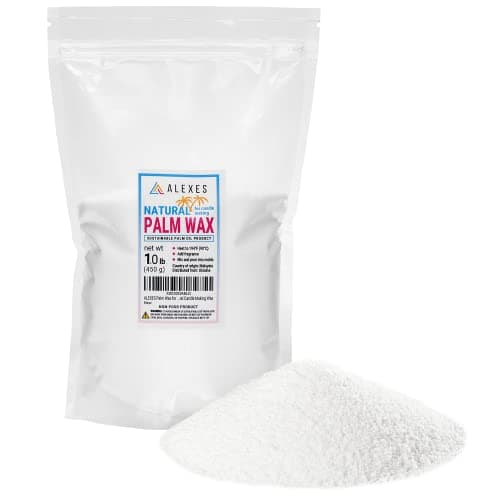 ALEXES Palm Wax for Candle Making, 1 lb FlakesTop pickThe only palm wax we found that publishes working figures at all. It states a 180F heat point and names the formats it is for, and those formats are pillars, votives, tapers and tealights - notably not containers. | The crystalline finish nothing else produces | |
| 2 | 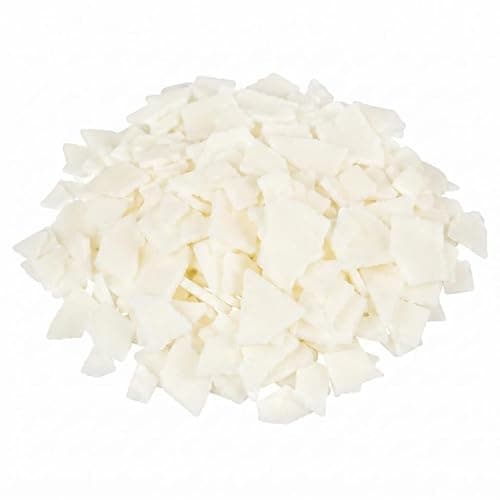 The Candlemaker's Store Natural Soy 464 Wax, 10 lb FlakesGW 464 is the reference soy for container candles, and that is its real advantage: when a wick chart says ECO 8, it was written with a wax like this in mind, so you get the behavior the chart predicts. | The wax most published wick charts are calibrated against | |
| 3 | 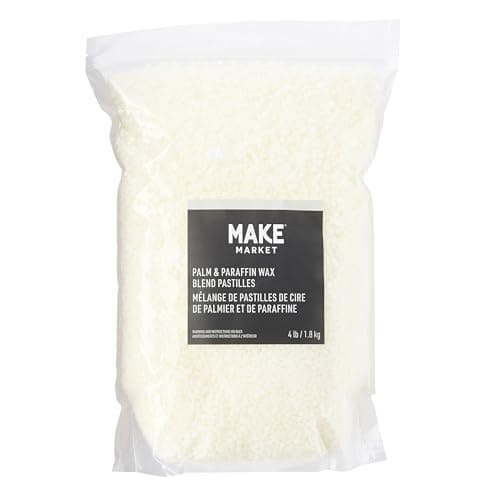 Make Market Candle Wax Pastilles, Palm and Paraffin Blend, 4 lbSixty percent palm and forty percent paraffin, stated plainly on the listing. Almost no blended wax publishes its ratio, and knowing it tells you roughly how much crystalline pattern to expect and how the wax will behave. | A published blend ratio, which is rare | |
| 4 | 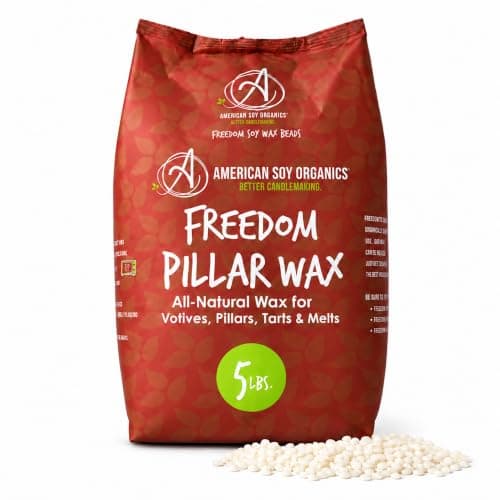 American Soy Organics Freedom Pillar Soy Wax Beads, 5 lbsPillar wax is a genuinely different formulation, harder and higher-melting, because nothing is holding the sides in. Using container soy in a mold is the most common reason a molded candle slumps. | Candles that stand up without a jar | |
| 5 | 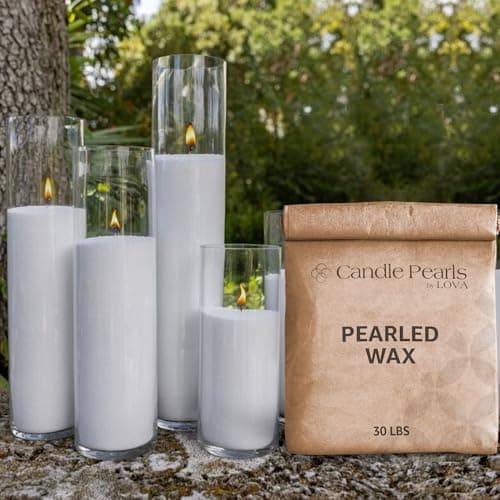 LOVA Candle Pearls Pearled Palm Wax, 30 lbGranulated palm wax poured dry into a vessel around a wick, with no melting at all. It is a real product and a genuinely nice effect, and it is not candle making in the sense the rest of this site means. | A different craft entirely, and worth knowing about | |
| 6 |  Palm Wax Flakes for DIY Scented CandlesA palm wax listing that publishes no specification of any kind. Not a melt point, not a pour temperature, not a fragrance load, not a weight. There is nothing here to make a decision with. | Nothing we can recommend it for |
Palm is the fifth candle wax, and the one our four-family comparison leaves out. It gets left out of most comparisons, and after a few hours of research the reason is fairly clear: there is very little published about it, and there is not much of it to buy.
That is not a reason to skip the comparison. Palm does one thing no other wax does, and if that thing is what you want, nothing else will substitute.
The one thing palm does that nothing else does
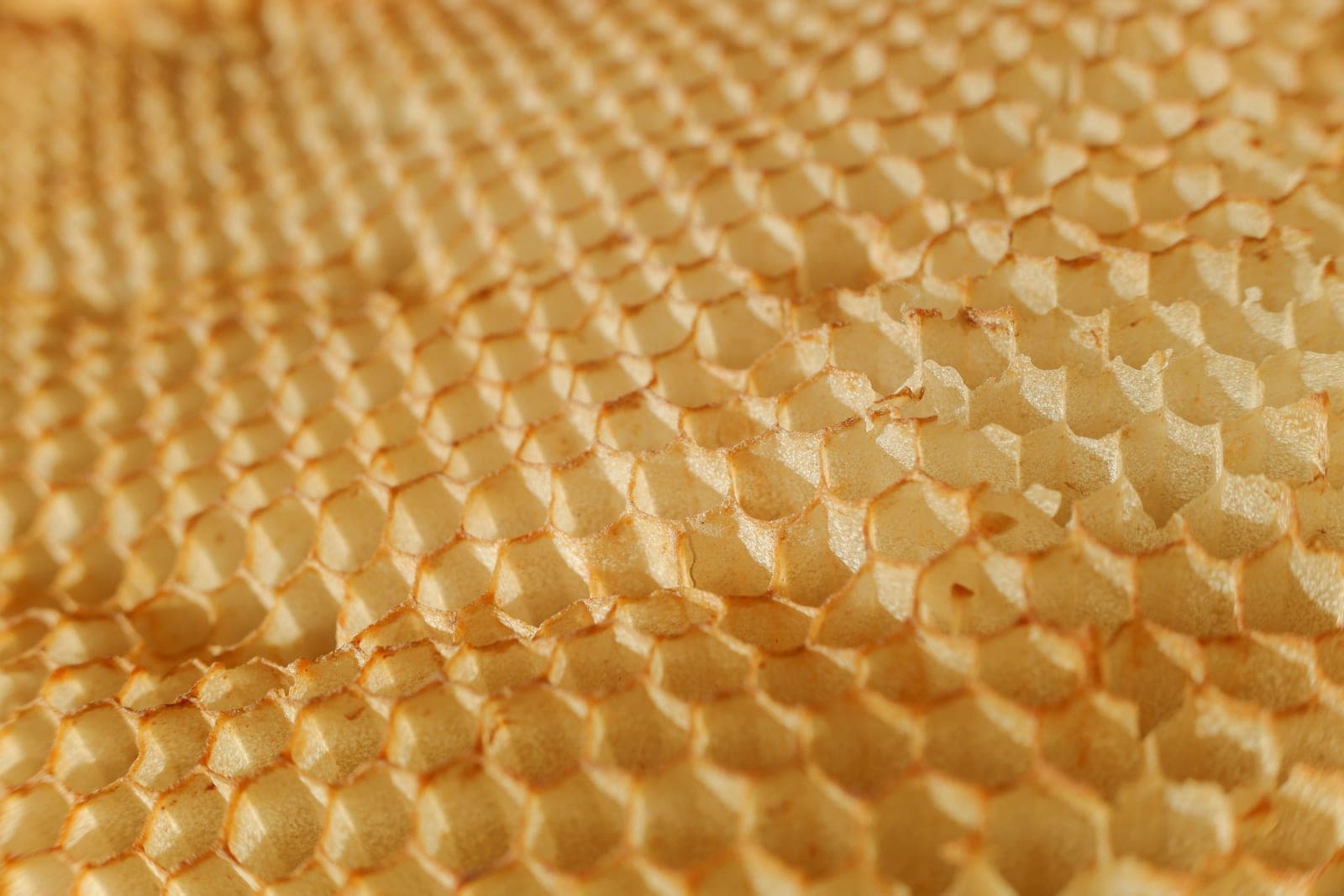
Palm wax crystallizes as it cools. Not the fine white bloom soy produces on the surface, which is frosting and is a cosmetic annoyance, but large visible crystal structures running through the whole body of the candle. Depending on how it is cooled you get a feathered, frosted or mottled pattern.
The ALEXES listing describes it as frosty patterns, which undersells it. This is the entire reason palm wax exists as a candle material. If you have seen a pillar candle with what looks like frost ferns across its surface, that was palm.
Side by side on what is checkable
| Soy | Palm | |
|---|---|---|
| Published melt point | 113 to 121F across three makers | Not published on any listing we found |
| Published pour temperature | 140F for GW 464 | Not published |
| Published heat temperature | 170 to 180F for GW 464 | 180F on the ALEXES listing |
| Published maximum fragrance load | 10 percent (1.6 oz per lb) | About 3 percent (0.5 oz per lb), and the listing contradicts itself |
| Wick charts written for it | Three, published directly for soy | None |
| Container candles | Yes, it is the standard | Not named among its uses |
| Pillars and votives | Needs a dedicated pillar blend | Yes, this is what it is for |
| Surface finish | Smooth, frosts over time | Feathered crystal, by design |
| Products available on Amazon | Dozens | Four, one of which is a paraffin blend |
| Sustainability certification named | Not applicable | Claimed, never certified on any listing |
The fragrance load gap is the biggest practical difference
This is the figure that surprised us most, and it is worth doing the arithmetic on rather than taking as a vague impression.
If scent throw is what you care about, that gap decides the comparison on its own. A candle capped at roughly a third of soy's fragrance load will not out-throw one running at 10 percent, and there is no additive that changes what the wax will hold. See how much fragrance oil per pound.
Palm is a wax you buy for how it looks, not for how it smells. That is a completely legitimate reason to buy a wax, and it is worth being clear about which one you are optimizing for.
Palm is a pillar wax, and that is not incidental
The ALEXES listing names pillars, votives, tapers and tealights. Containers are absent, and their absence is the informative part.
The mechanism is the same one that produces the crystal pattern. Palm contracts hard as it crystallizes, which is exactly what a mold wants (the candle releases cleanly) and exactly what glass does not (the wax pulls away from the wall). That is the container-against-pillar distinction on candle wax types explained, taken to its extreme.
So the real comparison for most people is not soy against palm in the abstract. It is palm against a pillar soy blend, because that is the job palm is applying for.
| Pillar soy | Palm | |
|---|---|---|
| Published melt point | 142 to 146F | Not published |
| Published pour temperature | 150 to 170F | Not published |
| Recommended wick series named | CD and ECO, on the listing | None |
| Surface | Smooth | Crystalline |
| Fragrance ceiling | 10 percent | About 3 percent published |
| Availability | Multiple sizes from named makers | One 1 lb bag with any figures at all |
Top pick · The crystalline finish nothing else produces
ALEXES Palm Wax for Candle Making, 1 lb Flakes
ALEXES
The only palm wax we found that publishes working figures at all. It states a 180F heat point and names the formats it is for, and those formats are pillars, votives, tapers and tealights - notably not containers.
#ad · how this is funded · price as of October 23, 2026
Published specifications
- Heat to
- 180F (82C)Source: Amazon product listing, read 2026-09-02
- Fragrance load
- Stated as up to 0.5 oz per 1 lb in one bullet and 0.5 to 1 oz per 1 lb in anotherSource: Amazon product listing, read 2026-09-02
- Formats named
- Pillars, votives, tapers, tealightsSource: Amazon product listing, read 2026-09-02
- Quantity
- 1 lb flakesSource: Amazon product listing, read 2026-09-02
- Stated finish
- Frosty crystalline patternsSource: Amazon product listing, read 2026-09-02
- Melt point
- Not published on the listing
- Pour temperature
- Not published on the listing
- Sustainability certification
- Described as sustainable, no certifier named
What that means
The listing contradicts itself on fragrance load: one bullet says up to 0.5 oz per pound and another says 0.5 to 1 oz per pound. Take the lower figure as the safe reading, which works out at about 3 percent by weight against soy's published 10 percent.
Containers are conspicuously absent from the list of formats. Palm wax contracts hard as it crystallizes, which is what produces the pattern and also what makes it pull away from glass.
Sustainable appears on the listing with no certifying body named. Palm oil sourcing has a real certification scheme behind it, and a listing that claims sustainability without naming one is making an unverifiable claim.
Good
- Publishes a heat temperature, which the other palm listings do not
- Names the formats it is actually for
- One pound, so trying palm costs very little
- Produces a crystalline surface no other candle wax makes
Less good
- The two fragrance load figures on the listing disagree with each other
- No published melt point or pour temperature
- Sustainability claim with no named certifier
- Not suitable for container candles
Skip this one if
You are pouring jar candles. Palm wax contracts hard as it sets, and the listing itself does not name containers among its uses.
Pick 2 · The wax most published wick charts are calibrated against
The Candlemaker's Store Natural Soy 464 Wax, 10 lb Flakes
Golden Brands (GW 464)
GW 464 is the reference soy for container candles, and that is its real advantage: when a wick chart says ECO 8, it was written with a wax like this in mind, so you get the behavior the chart predicts.
#ad · how this is funded · price as of October 23, 2026
Published specifications
- Melt point
- 115 to 120FSource: The Candlemaker's Store listing
- Melt point (maker figure)
- 113 to 118FSource: CandleScience product specification
- Heat to
- 170 to 180F, never above 200FSource: Cal Candle Supply published GW 464 instructions
- Add fragrance at
- 170FSource: Cal Candle Supply published GW 464 instructions
- Pour at
- 140FSource: Cal Candle Supply published GW 464 instructions
- Maximum fragrance load
- 10 percentSource: Cal Candle Supply published GW 464 instructions
- Quantity
- 10 lb flakesSource: Amazon product listing, read 2026-09-02
What that means
Two suppliers publish slightly different melt points for the same wax, 115 to 120F and 113 to 118F. That two-degree gap is normal for a natural wax and it is why you read your own pour temperature rather than trusting a single number.
Ten pounds is 160 ounces of wax, or roughly forty 4-ounce candles at the usual fill. That is a real supply, not a sample.
464 is a soy blend with additives that reduce frosting and hold fragrance better than straight soy. It is not the most natural wax on the shelf and it is not sold as one.
Good
- Every published temperature you need is documented, by more than one supplier
- The wax most wick charts assume, so chart recommendations behave as predicted
- 10 percent maximum fragrance load, which is at the top of what soy holds
Less good
- Contains soy-based additives, so it is a blend rather than pure soy
- Ten pounds is more than a first-time maker will get through
Skip this one if
You want to find out whether you enjoy this before committing to ten pounds of anything. Buy a one-pound bag first.
Pick 3 · A published blend ratio, which is rare
Make Market Candle Wax Pastilles, Palm and Paraffin Blend, 4 lb
Make Market
Sixty percent palm and forty percent paraffin, stated plainly on the listing. Almost no blended wax publishes its ratio, and knowing it tells you roughly how much crystalline pattern to expect and how the wax will behave.
#ad · how this is funded · price as of October 23, 2026
Published specifications
- Blend ratio
- 60 percent palm, 40 percent paraffinSource: Amazon product listing, read 2026-09-02
- Quantity
- 4 lb bagSource: Amazon product listing, read 2026-09-02
- Form
- PastillesSource: Amazon product listing, read 2026-09-02
- Maximum temperature
- Do not exceed 212F (100C)Source: Amazon product listing, read 2026-09-02
- Age guidance
- Not recommended for children under 15Source: Amazon product listing, read 2026-09-02
- Melt point
- Not published on the listing
- Fragrance load
- Not published on the listing
What that means
A published ratio is genuinely useful. Blending paraffin into palm moderates the crystallization, so a 60/40 blend gives a softer version of the palm pattern rather than the full feathered effect.
The paraffin fraction also means this is not a plant-only wax, which matters if palm was on your list for that reason rather than for the finish.
The 212F ceiling is a safety limit rather than a working temperature. It tells you what not to exceed, not what to pour at.
Good
- Publishes its blend ratio, which almost no blended wax does
- Pastilles rather than a block
- Four pounds is a workable quantity
- Clear maximum temperature
Less good
- No published melt point, pour temperature or fragrance load
- The paraffin fraction rules it out if you wanted a plant-only wax
- Less crystalline pattern than straight palm
Skip this one if
You chose palm for the full feathered crystal finish. Forty percent paraffin moderates exactly the effect you were buying it for.
Pick 4 · Candles that stand up without a jar
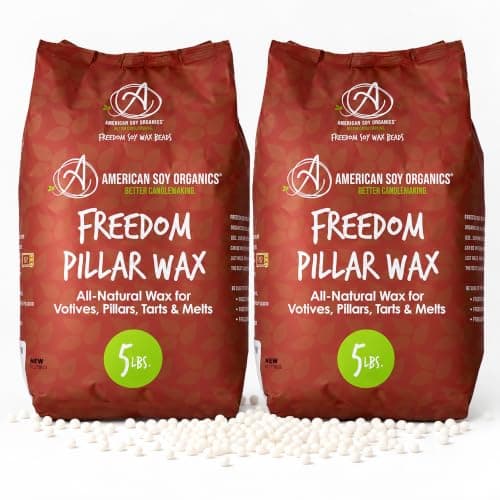
American Soy Organics Freedom Pillar Soy Wax Beads, 5 lbs
American Soy Organics
Pillar wax is a genuinely different formulation, harder and higher-melting, because nothing is holding the sides in. Using container soy in a mold is the most common reason a molded candle slumps.
#ad · how this is funded · price as of October 23, 2026
Published specifications
- Form
- Wax beadsSource: Amazon product listing, read 2026-09-02
- Quantity
- 5 lbsSource: Amazon product listing, read 2026-09-02
- Wax family
- Pillar soySource: Amazon product listing, read 2026-09-02
What that means
Pillar and container are not interchangeable. A container wax in a mold will not release cleanly and will bow in a warm room; a pillar wax in a jar will pull away from the glass and look terrible.
If you bought a kit with molds and it did not say which wax was included, this is the wax those molds actually wanted.
Good
- Correct formulation for molds
- Releases from molds cleanly
- Harder set
Less good
- Wrong wax for jars
- Higher pour temperature than container soy
Skip this one if
You are making jar candles. This is the wrong wax and it will pull away from the glass.
Pick 5 · A different craft entirely, and worth knowing about
LOVA Candle Pearls Pearled Palm Wax, 30 lb
LOVA
Granulated palm wax poured dry into a vessel around a wick, with no melting at all. It is a real product and a genuinely nice effect, and it is not candle making in the sense the rest of this site means.
#ad · how this is funded · price as of October 23, 2026
Published specifications
- Form
- Pearled or granulated wax, also sold as candle sand or candle powderSource: Amazon product listing, read 2026-09-02
- Quantity
- 30 lbSource: Amazon product listing, read 2026-09-02
- Wax
- Palm, described as plant basedSource: Amazon product listing, read 2026-09-02
- Method
- Poured dry around a wick, no meltingSource: Amazon product listing, read 2026-09-02
- Reusable
- Stated as reusable for a new candle each timeSource: Amazon product listing, read 2026-09-02
- Melt point
- Not published on the listing
What that means
Pearled wax is poured like sand into a glass, a wick is pushed into it, and it burns from the top down. There is no pot, no thermometer and no pour temperature, which is why it turns up in wedding and event decoration rather than in candle making guides.
The reusable claim is real in the sense that unburned granules can be topped up and re-wicked, which a poured candle cannot do.
Thirty pounds is an event quantity. This is not a way to try palm wax; it is a different product bought for a different reason.
Good
- No melting, no equipment and no temperature to hit
- Genuinely reusable in a way poured candles are not
- Distinctive look for events
Less good
- Not comparable to poured candle making
- Thirty pounds is an event-scale quantity
- No published melt point or burn data
Skip this one if
You want to make poured candles. This skips the entire process this site is about, which is the point of it and also why it is not an answer to soy against palm.
Pick 6 · Nothing we can recommend it for
Palm Wax Flakes for DIY Scented Candles
Generic (Amazon listing)
A palm wax listing that publishes no specification of any kind. Not a melt point, not a pour temperature, not a fragrance load, not a weight. There is nothing here to make a decision with.
#ad · how this is funded · price as of October 23, 2026
Published specifications
- Melt point
- Not published on the listing
- Pour temperature
- Not published on the listing
- Fragrance load
- Not published on the listing
- Quantity
- Not published on the listing
- Formats named
- Not published on the listing
What that means
The listing bullets read as keyword strings rather than product information. Every one of them is a phrase about scented candles and handmade gifts, and none states a fact about the wax.
Palm is already the wax family with the least published guidance. A palm listing with no figures at all leaves you testing from absolute zero: unknown melt point, unknown pour temperature, unknown load ceiling.
We include it because it is what the search results actually look like in this category, and because knowing that is useful before you assume palm wax is as well documented as soy.
Good
- It is palm wax
- It is currently in stock
Less good
- No published specification of any kind
- No stated quantity, so cost per pound cannot be computed
- Nothing to distinguish it from any other unbranded bag
Skip this one if
Always, unless nothing else is available. This is the pick we would skip: with no melt point and no pour temperature, every candle is an experiment with no starting point.
Wicking palm, which nobody will help you with
We transcribed four published wick charts for the main wick size chart. Not one of them has a palm column. There is no palm equivalent of the paraffin baseline or the soy adjustment, and no palm listing names a wick series the way the pillar soy listing names CD and ECO.
What can be said honestly, and no more than this: palm behaves as a hard, high-melting wax, which is the same direction beeswax sits in relative to soy. The published beeswax instruction is to increase one to two ECO sizes over the soy row, and that is the nearest documented analogue rather than a palm figure.
Practically: pillars are wicked to keep the melt pool short of the edge rather than out to the wall, buy three adjacent sizes, and burn-test properly. There is more testing in palm than in any other wax on this site, and that is a real cost.
The sourcing question, stated plainly
Palm wax comes from palm oil, and palm oil cultivation carries a well-documented association with tropical deforestation. That is the reason a lot of makers avoid it, and it is a reasonable thing to weigh.
It is also the reason a certification scheme exists. The Roundtable on Sustainable Palm Oil certifies supply chains, and a certified product carries a named certification you can check.
Here is the checkable finding: neither palm wax listing we examined names a certifier. The ALEXES listing uses the word sustainable in its product title and its bullets and names nobody. That is exactly the pattern eco-friendly candle wax sets out, where a claim with no named certifier should be read as decoration rather than a fact.
We are not telling you palm is unsustainable. We are telling you that no listing in this category gives you the evidence to conclude either way, and that if this matters to you, an uncertified sustainability claim is not the evidence you need.
Availability is a real constraint
We searched the category thoroughly. Four palm products came back that are candle-relevant and currently purchasable: one 1 lb bag of flakes with any published figures, one palm-paraffin blend, one bag of flakes with no specification at all, and a 30 lb sack of granulated pearls for a different craft entirely.
Compare that with soy, where a dozen named products publish melt points and pour temperatures across quantities from 1 lb to 45 lb. If you settle on palm and your supplier stops carrying it, there is no obvious second choice, and that is a genuine risk for anyone making candles to sell.
The two we would skip
The unbranded palm flakes are last on this list and we would not buy them. The listing publishes no melt point, no pour temperature, no fragrance load and no weight. Palm already has the least documentation of any wax family; a palm listing with nothing at all means every candle is an experiment with no starting point.
The pearled wax is a different thing rather than a bad thing. Granulated palm poured dry around a wick, no melting, no thermometer, no pour temperature. It makes an attractive vessel candle and it skips the entire process this site is about, so it is not an answer to the question this page is asking.
Which one to buy
- You want the crystal finish: palm, and accept that you are testing from scratch. Nothing else makes that surface.
- You are making jar candles: soy. Palm's own listing does not name containers, and the contraction that makes the pattern also pulls it off the glass.
- Scent throw is the priority: soy, decisively. Roughly 10 percent published load against roughly 3 percent.
- You are making pillars and want a documented process: pillar soy, which publishes melt point, pour temperature and a recommended wick series.
- You want some of the pattern with less testing: the palm-paraffin blend, which publishes its 60/40 ratio.
- You are making candles to sell: soy. Availability, documentation and repeatability all point the same way, and selling candles turns on exactly those three.
The honest summary: palm is a specialist wax bought for one visual effect, with less published information behind it than anything else on this site. That is not a reason to avoid it. It is a reason to buy one pound first.
How these picks were made. Published specifications compiled from the sources listed below, the arithmetic shown on the page, and live Amazon prices. No product here has been burned by us. Read the method.
Common questions
Is palm wax better than soy wax?
For one thing, yes: palm produces a feathered crystalline surface that no other candle wax makes. On everything checkable - published melt points, pour temperatures, wick charts, fragrance load ceiling and availability - soy is substantially better documented and easier to work with.
Can you use palm wax for container candles?
The ALEXES palm wax listing names pillars, votives, tapers and tealights, and does not name containers. Palm contracts hard as it crystallizes, which releases cleanly from a mold and pulls away from glass.
How much fragrance oil can palm wax hold?
The ALEXES listing gives up to 0.5 oz per pound in one bullet and 0.5 to 1 oz per pound in another. The lower figure works out at about 3 percent by weight, against soy's published 10 percent maximum.
What wick do you use for palm wax?
None of the four published wick charts we transcribed has a palm column, and no palm listing names a wick series. Palm behaves as a hard, high-melting wax, so it sits in the same direction as beeswax, but there is no published instruction to derive a chart from. Buy three adjacent sizes and burn-test.
Is palm wax sustainable?
Palm oil cultivation carries a documented association with tropical deforestation, and a certification scheme exists for sustainable supply chains. Neither palm wax listing we examined names a certifier, so the sustainability claims on them are not verifiable either way.
Why does palm wax look crystallized?
Palm crystallizes structurally as it cools, forming visible crystal patterns through the body of the candle. That is different from soy frosting, which is a surface bloom that appears over weeks and is generally considered a cosmetic fault.
Where can I buy palm wax for candles?
It is genuinely scarce. Our search of the category found four candle-relevant palm products currently purchasable, one of which is a palm-paraffin blend and one of which is granulated pearled wax for a different craft. Soy has a dozen named products across quantities from 1 lb to 45 lb.
Sources
- Cal Candle Supply - Golden Wax 464 published instructions (heat, fragrance and pour temperatures)
- CandleScience - Golden Brands 464 soy wax product specifications
- The Candlemaker's Store - Natural Soy 464 Wax listing (115-120F melt point)
- Lone Star Candle Supply - Guide to Wicking (ECO, CD, HTP, LX, zinc and wooden wick charts)
- Tools for Makers - Candle Wick Size Chart for Soy, Paraffin and Beeswax
Read next
Candle Wax
Soy, beeswax, paraffin and coconut blends compared on published melt points, pour temperatures and maximum fragrance loads.
Soy vs Beeswax vs Paraffin vs Coconut
The four wax families compared on melt point, scent throw, cost, difficulty and required wick adjustment, with picks for each.
Best Soy Wax for Pillar Candles
Pillar soy waxes ranked on published melt point and pour temperature, with the thirty-degree gap that separates them from container wax.
Top pick
American Soy Organics Freedom Pillar Soy Wax Beads, 10 lbs
Eco-Friendly Candle Wax
What natural, non-toxic, clean burning and eco-friendly actually mean on a wax listing, and the claims that are genuinely verifiable.
Candle Wax Types Explained
Every candle wax type explained: the four families, container against pillar formulation, blends, additives and grades.
Candle Wick Size Chart
ECO, CD, HTP, LX, zinc and wooden wick sizes from four published charts, cross-referenced by container diameter with every publisher named.