Learn Candle Making
Candle Making vs Soap Making
Two crafts, one melting pot. What actually differs is the hard decision each one makes you take.
We have not burned these candles and we do not claim to have. Here is what we did instead. Links to Amazon earn us a commission at no extra cost to you — disclosure.
| # | Product | Best for | Price |
|---|---|---|---|
| 1 | 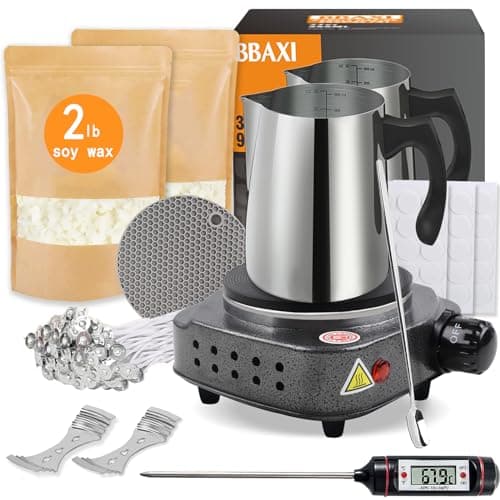 BBAXI Candle Making Kit with Hot Plate and 2 lb Soy WaxTop pickTwo pounds of soy wax, stated on the listing, so you can cost it per candle before buying. Four of the seven kits we track now publish a weight; what still sets this one apart is the two centering devices almost every other kit leaves out. | A published wax weight, and the parts kits usually omit | |
| 2 | 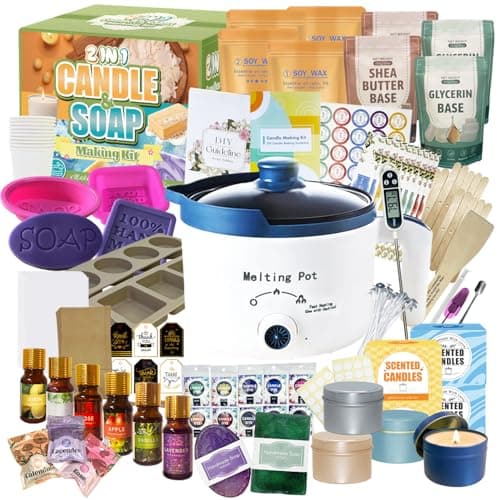 PIUH 2-in-1 Candle and Soap Making KitThe only kit on this site that publishes how its material divides between the two crafts: 2 lb of wax and 2 lb of soap base, stated separately. That is the figure the larger Deluxe box leaves as one combined number, and it is the difference between knowing what you bought and guessing. | Trying both crafts in one box, with the split published | |
| 3 | 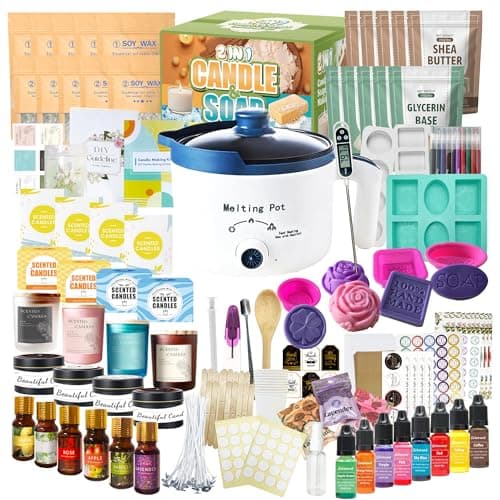 PIUH Deluxe 2-in-1 Candle and Soap Making Kit with MelterThe largest and heaviest box on this page, and the only one that is half a soap kit. If soap is not on your list then a third of what you are paying for is molds and base you will not use. | Two crafts in one box, if you actually want both |
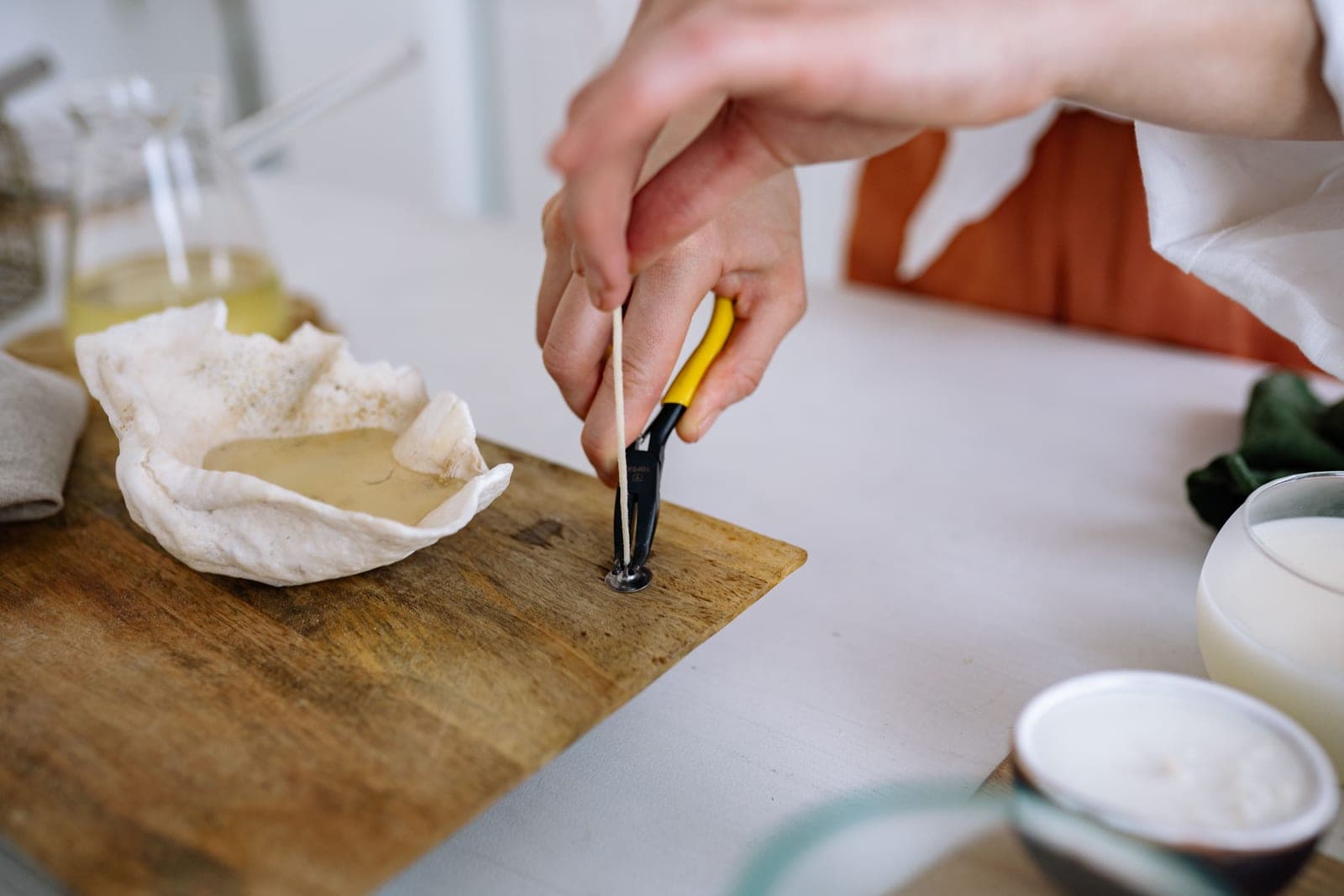
Candle making and soap making get recommended together, sold together and taught together, and the reason is not that they are similar crafts. It is that they need most of the same equipment. You melt something, you scent it, you color it, you pour it into a shape and you wait.
Where they separate is what each one asks you to get right. One has a single unavoidable technical decision. The other has almost none at the beginner level, and a steeper step up to the level beyond it.
What the two crafts share
This is the part the kit sellers are right about. If you own the equipment for one, you own most of the equipment for the other:
- A heat source and a pouring vessel. Both crafts melt a solid and pour a liquid. The 2-in-1 kits below ship one electric melting pot and state that it serves both.
- A thermometer. Essential for candles, useful for soap.
- A scale. Fragrance is dosed by weight as a percentage of what you are scenting, in both crafts.
- Fragrance oil and dye. The same bottles, with one caveat worth knowing: an oil sold for candles is not automatically skin-safe. The 2-in-1 kits below state that their fragrances are intended for both; a candle-only fragrance oil makes no such claim and should not be assumed to carry it.
- Molds. Silicone molds work for soap and for pillar candles and wax melts.
What does not carry over is small: wicks, wick stickers and containers are candle-only; soap molds and soap base are soap-only.
| Candle making | Soap making, melt and pour | |
|---|---|---|
| What arrives in a kit | Wax, wicks, containers, fragrance, dye | Pre-made soap base, molds, fragrance, dye |
| Heat source needed | Yes | Yes |
| Chemistry you perform | None. Wax is melted, not changed | None with a base. The reaction already happened in a factory |
| The one hard decision | Wick size against container diameter | None at base level |
| Published temperatures to hit | Yes. GW 464 heats to 170 to 180F, fragrance at 170F, pour at 140F | None published on any kit listing here |
| Wait before it is usable | Soy cures 1 to 2 weeks for scent | Solid once cool; the kits sell it as a same-day result |
| How a beginner fails | Wrong wick: tunneling, soot, no scent throw | Overheating the base, or over-dosing fragrance |
| Step up to the next level | Named wax, burn testing, your own wick data | Cold process, which means handling alkali yourself |
| Who regulates what you made, in the US | No federal labeling statute. Voluntary ASTM and NCA standards | CPSC if it is true soap, FDA if it is a cosmetic |
The decision candle making forces on you
A candle is a fuel system. The wick has to pull melted wax up at the rate the flame consumes it, and that rate depends on the diameter of your container, the wax, the fragrance load and the dye. Get it wrong in one direction and the flame cannot keep a full melt pool, which is tunneling. Get it wrong in the other and you get soot, a mushrooming wick and a jar too hot to hold.
There is no way around this decision, and no kit removes it: the kit simply picks for you and hopes its single wick size suits every container in the box. The honest route is the wick size chart, which puts four manufacturers' published sizing side by side, including the rows where they disagree by two full sizes, and then burn testing two candles with different wicks to see which your actual wax does better with.
That is the craft. It is also why a first candle often disappoints and a fourth one does not.
What soap making asks instead
Soap is a chemical reaction: fats or oils combined with an alkali. The US Food and Drug Administration's own definition of soap, at 21 CFR 701.20, describes a product composed mainly of the alkali salts of fatty acids, which is what you get when you combine fats or oils with an alkali such as lye.
Every kit on this page ships a soap base, and that word is doing the important work. A base is soap that has already been made. The reaction happened in a factory, so what you do at home is remelt it, color it, scent it and pour it, and no alkali passes through your kitchen. That is the entire reason a soap kit can be sold to a beginner as an afternoon.
The step beyond base is cold process, where you combine the oils and the alkali yourself. That is a different undertaking with a genuine chemical hazard in it, and it is outside what this site covers or ranks. The point for a comparison is structural: candle making gives you its hard problem on day one, and soap making keeps its hard problem behind a door you have to choose to open.
What you are legally making
This is the difference nobody mentions, and it matters the moment you sell or give away what you made.
For candles there is no federal labeling statute. The standards that exist are voluntary industry ones, principally ASTM F2417 for fire safety, and the National Candle Association's guidance on what a candle label should carry. Candle safety and labeling sets out what to put on a label and why, and selling candles covers the rest of the commercial side.
Soap is the more complicated one, because which agency regulates it depends on what it is made of and on what you say about it. The FDA's three-part test is specific:
- It must be composed mainly of the alkali salts of fatty acids.
- Those alkali salts must be the only thing producing the cleaning action. If the product contains synthetic detergents, the FDA says it is a cosmetic, not a soap.
- It must be labeled and marketed only for use as soap.
Pass all three and the product is regulated by the Consumer Product Safety Commission rather than the FDA. The CPSC states that it has no soap-specific labeling regulations and oversees no requirement to list a soap's ingredients, but that any household product meeting the Federal Hazardous Substances Act definition of a hazardous substance must carry cautionary labeling.
Nothing about that should stop anyone making soap at home for themselves. It is worth knowing before a market stall, and it is the kind of thing that is far easier to get right at the start than to unpick later.
Top pick · A published wax weight, and the parts kits usually omit
BBAXI Candle Making Kit with Hot Plate and 2 lb Soy Wax
BBAXI
Two pounds of soy wax, stated on the listing, so you can cost it per candle before buying. Four of the seven kits we track now publish a weight; what still sets this one apart is the two centering devices almost every other kit leaves out.
#ad · how this is funded · price as of October 17, 2026
Published specifications
- Wax quantity
- 2 lb soy waxSource: Amazon product listing, read 2026-09-02
- Heat source included
- Electric hot plate, 500 watts, 5 heat settingsSource: Amazon product listing, read 2026-09-02
- Pouring pot
- 304 stainless steel double pot, holds 32 oz / 900 mlSource: Amazon product listing, read 2026-09-02
- Pot dimensions
- 5.2 x 4 x 4.2 inchesSource: Amazon product listing, read 2026-09-02
- Wick hardware
- 2 stainless centering devices, 60 wicks, 60 wick stickersSource: Amazon product listing, read 2026-09-02
- Also includes
- Stainless spoon, silicone anti-scald padSource: Amazon product listing, read 2026-09-02
What that means
Two pounds is 32 ounces of wax. At the 0.8 fill factor soy runs at, that is roughly ten 4-ounce candles or five 8-ounce candles, before you account for what stays in the pot.
When we first wrote this up, one kit in seven published a wax weight. Re-checking the listings on 2026-09-21, four of the seven now do. Being able to do that arithmetic in advance is still worth more than an extra bottle of unnamed fragrance oil.
The two centering devices matter more than they sound. Kits almost always ship wick stickers and no holders, and an off-center wick is the most common cosmetic failure in a first batch - this is the only kit here that includes both.
A published pot capacity of 32 oz is a genuinely useful figure: it tells you the kit melts its entire 2 lb of wax in one go rather than in two batches at different temperatures.
Good
- Publishes the wax weight, so cost per candle is computable before purchase
- Hot plate and 304 stainless pouring pot both included
- Includes centering devices, which nearly every other kit omits
- Publishes the pot capacity and dimensions
Less good
- Fewer decorative extras than the gift-framed kits
- Fragrance oils are unnamed, so they cannot be re-ordered
- The listing notes the pot smokes slightly on first use as a protective film burns off
Skip this one if
You are buying a present and want it to look like one out of the box. This kit is the practical choice, not the pretty one.
Pick 2 · Trying both crafts in one box, with the split published
PIUH 2-in-1 Candle and Soap Making Kit
PIUH
The only kit on this site that publishes how its material divides between the two crafts: 2 lb of wax and 2 lb of soap base, stated separately. That is the figure the larger Deluxe box leaves as one combined number, and it is the difference between knowing what you bought and guessing.
#ad · how this is funded · price as of October 17, 2026
Published specifications
- Wax
- 2 lb soy wax, pre-portionedSource: Amazon Creators API item data, read 2026-10-10
- Soap base
- 2 lb soap base, pre-portioned; described as cosmetic-grade and SLS-freeSource: Amazon Creators API item data, read 2026-10-10
- Heat source included
- Electric melting pot, stated to work for both wax and soap baseSource: Amazon Creators API item data, read 2026-10-10
- Fragrance and color
- 8 fragrances the listing describes as phthalate-free, plus dyesSource: Amazon Creators API item data, read 2026-10-10
- Also includes
- Reusable silicone molds, thermometer, color-coded instructions for both crafts, gift packagingSource: Amazon Creators API item data, read 2026-10-10
- Model
- C+SMK-P1Source: Amazon Creators API item data, read 2026-10-10
- Container count
- Not published on the listing
- Shipping weight
- Not published on the listing
What that means
Two pounds of wax is a real quantity: enough for roughly ten 8-ounce candles before you account for the soap half, which makes this a kit you can learn on rather than a single evening.
Because the soap half arrives as a base rather than as oils and alkali, the chemistry is already done. You melt it, color it, scent it and pour it, which is why a kit like this can be sold to a beginner at all.
The listing carries a claim that 92 percent of testers made a presentable product first time. There is no methodology behind that figure anywhere on the page, so treat it as marketing rather than evidence.
Good
- Publishes the wax and soap-base weights separately, which no other kit here does
- Includes a thermometer and a melting pot that work for both crafts
- One box answers the question this page is about without buying two kits
Less good
- Publishes no container count, so how many candles you can actually pour is unknown
- Fragrance, dye and base claims are the seller's own, with no certification named
- The tester statistic on the listing has no methodology behind it
Skip this one if
You already know you want candles. Half of what you are paying for is soap base and soap molds, and a candle-only kit puts the whole budget into the craft you are actually going to do.
Pick 3 · Two crafts in one box, if you actually want both
PIUH Deluxe 2-in-1 Candle and Soap Making Kit with Melter
PIUH
The largest and heaviest box on this page, and the only one that is half a soap kit. If soap is not on your list then a third of what you are paying for is molds and base you will not use.
#ad · how this is funded · price as of October 17, 2026
Published specifications
- Heat source included
- Electric melting pot, described as working for both wax and soap baseSource: Amazon Creators API item data, read 2026-10-06
- Wax and soap base
- 4 lb of soy wax and soap base; the listing does not say how that total dividesSource: Amazon Creators API item data, read 2026-10-06
- Containers
- 4 jars and 4 glass cupsSource: Amazon Creators API item data, read 2026-10-06
- Molds
- 7 soap moldsSource: Amazon Creators API item data, read 2026-10-06
- Fragrance and color
- 6 essential oils and 8 dyesSource: Amazon Creators API item data, read 2026-10-06
- Also includes
- Thermometer, stainless steel and wooden spoons, 10 wooden sticks, 3 dried flowers, gift packagingSource: Amazon Creators API item data, read 2026-10-06
- Model
- etjykit-SY-LZ-9-1Source: Amazon Creators API item data, read 2026-10-06
- Shipping weight
- 17.26 lb for the whole boxSource: Amazon Creators API item data, read 2026-10-06
- Candle wax weight on its own
- Not published on the listing
What that means
At 17.26 lb shipped this is more than three times the weight of any other box here, and that weight is the honest signal: there is a lot of material in it. The catch is that the published 4 lb figure covers soy wax and soap base together, so the candle half of the kit is unquantified.
The listing describes its contents twice and the two lists do not reconcile. One bullet says 4 lb of wax and base, 8 dyes, 6 essential oils, 4 jars and a glass cup; another says soy wax times 10, soap base times 10, jar times 4, glass cup times 4. Buy on the second list and treat the counts as the firmer claim.
The savings claim on the listing, up to 40 percent against buying everything separately, is the seller's arithmetic and names none of the prices it compares. Soap making also wants a lye-safe setup and a different skill, so the second craft is not free in effort even when it is free in money.
Good
- By far the most material of any kit here, and publishes a shipping weight to prove it
- The melting pot and thermometer carry over to candle making whatever you do with the soap half
- Publishes a 4 lb wax and base figure, where most premium kits publish none
Less good
- The 4 lb figure covers wax and soap base together, so the candle wax weight is unknown
- Two contents lists on the same listing that do not reconcile
- Seven soap molds are dead weight if you only want candles
Skip this one if
You only want to make candles. On candle contents alone this is not the most generous box here, and you would be buying soap equipment to find that out.
If you are buying one box
The three picks above answer three different versions of the question, and the order is not a ranking of quality:
- You have decided on candles. The BBAXI kit is the one to buy. It publishes a 2 lb wax weight, a 32 oz pot capacity and a hot plate with five heat settings, and it includes the thermometer and the centering devices that kits usually leave out.
- You genuinely want to try both. The smaller PIUH 2-in-1 publishes its split, 2 lb of wax and 2 lb of soap base stated separately, which is the only kit here that tells you how much of each craft you are buying.
- You want the largest box of both. The PIUH Deluxe ships by far the most material, 17.26 lb of it, but publishes its 4 lb figure as wax and soap base combined, so the candle half is unquantified.
One caution on the 2-in-1 route: half of what you pay for is the craft you may not continue with. If the comparison on this page has already settled it for you, a single-craft kit puts the whole budget into the thing you are actually going to do. Best candle making kits for beginners ranks the candle-only boxes on published wax weight and heat source.
Cost, honestly
The 2-in-1 kits sit well above the ordinary candle starter-box band, which is what you would expect from a box carrying two crafts' worth of material. Per unit made, neither craft is a way to save money against buying the finished article: is it cheaper to make candles runs that arithmetic in full, and the answer is that you are buying control and the making, not a discount.
Which to start with
If you want a craft that rewards getting better at it, candle making is the stronger choice, and the reason is the wick. It gives you something to measure, test and improve, and the published sizing data to do it against. The first candle teaches you what a melt pool is; the fourth one is a candle you would give away.
If you want a reliable result the first time, or you are making something with a child, melt-and-pour soap is the gentler entry: no flame in the finished product, no sizing decision, and a result the same day. Best candle making kits for kids makes the same argument on the candle side, which is that the kits worth buying for a child need no heat at all.
And if you cannot decide, that is what the 2-in-1 boxes are for. Just buy the one that tells you how it divides. How to make candles is the full process on the candle side, start to finish, so you can read what you are signing up for before you spend anything.
How these picks were made. Published specifications compiled from the sources listed below, the arithmetic shown on the page, and live Amazon prices. No product here has been burned by us. Read the method.
Common questions
Is candle making or soap making easier?
Melt-and-pour soap is easier to get right first time, because the chemistry is already done and there is no wick to size. Candle making has one genuinely hard decision in it, the wick size for your container, and that is also what makes it the more interesting craft to continue with.
Can I use the same equipment for candles and soap?
Mostly yes. The melting pot, thermometer, scale, dyes and silicone molds all carry over, which is why 2-in-1 kits exist. Wicks, wick stickers and jars are candle-only, and soap base and soap molds are soap-only.
Do I need to handle lye to make soap?
Not with a melt-and-pour base, which is what every kit here ships. A base is soap that has already been made, so you remelt, color, scent and pour it. Handling alkali yourself is cold process, a separate undertaking that this site does not cover.
Can I use candle fragrance oil in soap?
Do not assume it. An oil sold for candles makes no skin-safety claim, and a candle is not applied to skin. The 2-in-1 kits state that their fragrances are intended for both uses; a candle-only fragrance oil does not, and you should treat the absence of the claim as the answer.
Which is better to sell, candles or soap?
They sit under different rules. Candles have no federal labeling statute in the US, only voluntary ASTM and NCA standards. Soap is regulated by the CPSC if it meets the FDA's definition of true soap, and by the FDA as a cosmetic if it contains synthetic detergents or if you make moisturizing or scent claims about it. The paperwork is lighter on candles.
How long does each one take to be usable?
Melt-and-pour soap is solid once it cools and the kits sell it as a same-day result. A soy candle is safe to burn the next day but needs one to two weeks for the fragrance to bind properly, so the candle is the one that asks you to wait.
Sources
- Cal Candle Supply - Golden Wax 464 published instructions (heat, fragrance and pour temperatures)
- U.S. Food and Drug Administration - Frequently Asked Questions on Soap (the 21 CFR 701.20 definition)
- U.S. Consumer Product Safety Commission - Soap FAQ (jurisdiction and cautionary labeling)
- National Candle Association - candle labeling and fire safety standards (ASTM F2058, F2417, F2179)
- ASTM F2417 - Standard Specification for Fire Safety for Candles
Read next
Learn Candle Making
Step-by-step candle making guides, the fixes for the common failures, and comparisons with wax melts and warmers.
How to Make Candles
The complete candle making walkthrough: equipment, wax and fragrance arithmetic, published temperatures, the pour, the cure and the fixes.
Making Candles to Sell
What actually changes when candles go from gifts to product: repeatability, fire safety labeling, batch records and honest cost per candle.
Is It Cheaper to Make Candles Than Buy Them?
Making against buying, worked as arithmetic rather than asserted: materials per candle, one-off equipment amortized, and the break-even count.
Candle Safety and Labeling
Candle fire safety guidance and the US labeling standards that apply to candles you sell, with the warnings a label must carry.
Candle Wick Size Chart
ECO, CD, HTP, LX, zinc and wooden wick sizes from four published charts, cross-referenced by container diameter with every publisher named.