Wicks and Wick Sizing
Best Wood Wicks for Candle Making
Sized by width, sold by length, and the listings disagree with the published charts about both.
We have not burned these candles and we do not claim to have. Here is what we did instead. Links to Amazon earn us a commission at no extra cost to you — disclosure.

| # | Product | Best for | Price |
|---|---|---|---|
| 1 | 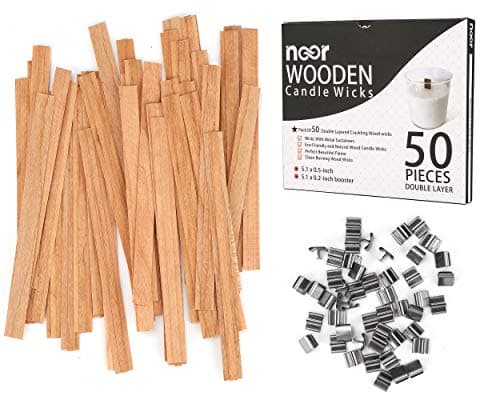 NOOR Double Layer Crackling Wood Wicks with Clips, 50 packTop pickThis is the booster construction the wooden wick charts keep referring to: a wide base ribbon bonded to a narrower one. It exists precisely because single-ply wooden wicks underperform in soy. | Wooden wicks in soy, where a single ribbon is not enough | |
| 2 | 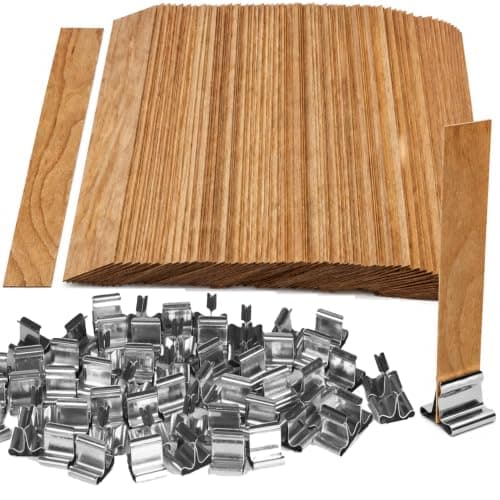 Cherry Wood Candle Wicks, 0.75 x 5.12 inchThe only wooden wick listing we found that publishes width, thickness and the container diameter it is intended for. Wooden wicks are sized by width, so a listing without it is a guess. | A published width, a published thickness and a published container size | |
| 3 | 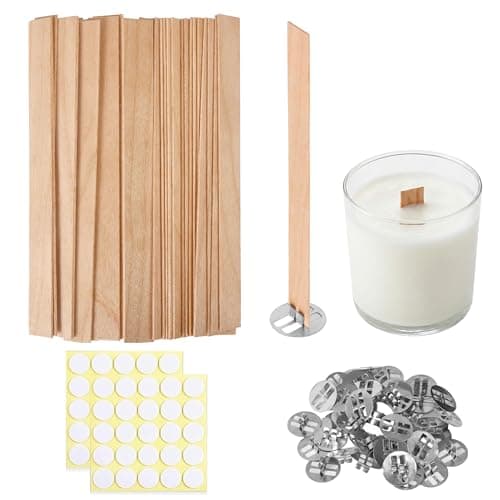 150 Piece Thickened Wooden Candle Wicks, 5.1 x 0.5 inchWooden wicks are bought for the sound, and they are the single hardest wick to size correctly in soy. The published charts disagree with each other by a full size on exactly this question. | The crackle, in a 2.5 to 3 inch jar | |
| 4 | 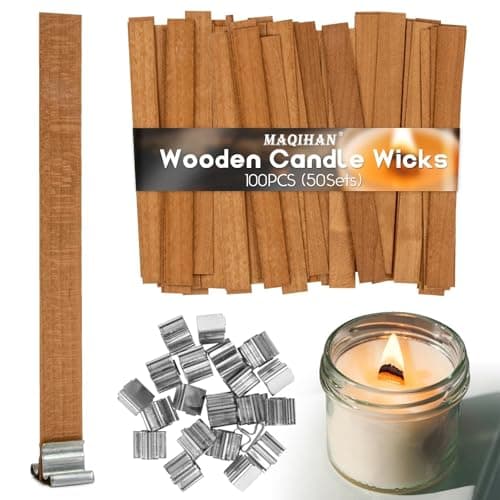 MAQIHAN Wood Wicks for Candle Making, 0.5 x 5.1 inchA narrower wick with its container range published to a tenth of an inch, and an unusually honest instruction: for soy, use two of them. Most listings would rather sell you one. | Narrow jars, and a listing that tells you to double up in soy | |
| 5 | 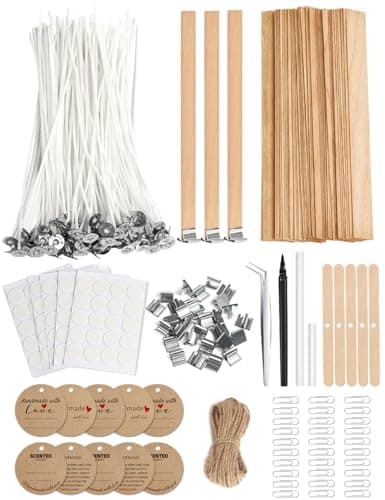 Multiwins 130 Piece Candle Wick Kit with Cotton and Wood Wicks and ToolsOne hundred cotton and thirty wood, plus the holders and stickers. As a way to find out which wick family you actually like, it beats buying two separate packs. | Trying both wick families before committing |
People buy wooden wicks for the crackle and then spend a month finding out they are the hardest wick in candle making to size. This page is about the second part, because the first part is not in dispute: they do crackle, and it is lovely.
Two publishers print wooden wick charts, the sellers publish their own container ranges, and the two sets of numbers do not agree. That disagreement is the whole content of this category and nobody else seems to print it.
Width is the size. Length is packaging.
A wooden wick listing leads with a length, usually about 5 inches, because that is what fits a jar. The number that decides whether the candle works is the width of the ribbon, and after that its thickness.
A wider ribbon exposes more burning edge, throws more heat and melts a wider pool. A thicker one holds a flame more reliably and is harder to light. Length only has to clear the top of your jar.
The two published charts
| Size | Soy, up to | Paraffin, up to |
|---|---|---|
| Small | not recommended | 2.25" |
| Medium | 2.25" | 3" |
| Large | 3.25" | 3.25" |
| X-Large | 3.5" | 3.75" |
Small wooden wicks are published as not recommended for soy at any diameter.
| Size | Soy, up to | Paraffin, up to |
|---|---|---|
| 0.375 inch ribbon | 2.5" | 2.5" |
| 0.5 inch ribbon | 3" | 3" |
| 0.625 inch ribbon | 3.5" | 3.5" |
| 0.75 inch ribbon | 4" | 4" |
Published with a caution that pure soy usually needs a booster or a double-ply wick.
Read those two tables against each other and the problem is obvious. Lone Star publishes by descriptive size, so Small, Medium, Large, and states that Small is not recommended for soy at any diameter. Tools for Makers publishes by actual ribbon width in inches, which is the more usable form, and attaches a caution that pure soy usually needs a booster or double-ply wick.
Soy is the hard case, and everybody says so
This is the one point where every source agrees, and it is worth stating plainly because it contradicts what the photographs on the listings suggest.
- Lone Star publishes that small wooden wicks are not recommended for soy at any diameter.
- Tools for Makers attaches a caution that pure soy usually requires a booster or a double-ply wick.
- One of the manufacturers in our picks says the same thing in its own listing: for soy wax, use a double wick.
A publisher, a second publisher and a seller who loses a sale by saying it. That is as close to consensus as this category gets, and it is why the double-layer wick is ranked first here.
Why a wooden wick goes out
Almost every wooden wick failure is one of four things, and three of them are preparation rather than size.
- It was never primed. Several of these wicks ship unwaxed. The published fix is a soak in carrier oil or melted wax, 20 to 30 minutes depending on the listing, then wipe or pat dry.
- It was trimmed too long. The published trim for a wooden wick is 1/8 to 1/4 inch, shorter than a cotton wick. A tall wooden wick chars and drowns.
- It is too thin for soy. See above. One ribbon where the chart wanted two.
- The wax is too deep and the pool too cold. A wooden wick needs a proper melt pool to sustain itself, which is why the first burn matters more here than anywhere else. Candle tunneling covers the first-burn rule.
How we picked
- Published ribbon width and thickness. The two figures that size the wick. Three of the five publish a width.
- A published container range, even where it conflicts with the chart. A seller who publishes a number can be checked; one who does not, cannot.
- Construction that matches the published soy caution. Double-layer and booster wicks exist because single ribbons underperform in soy, and both charts say so.
- Published preparation instructions. An unwaxed wick with no soak instruction on the listing is a wick that will go out and not tell you why.
- Honest contents counts. Two listings here sell 100 pieces that are 50 wicks plus 50 bases. We say so in the write-ups.
We have not burned these wicks. The full method is on how we pick.
Top pick · Wooden wicks in soy, where a single ribbon is not enough
NOOR Double Layer Crackling Wood Wicks with Clips, 50 pack
NOOR
This is the booster construction the wooden wick charts keep referring to: a wide base ribbon bonded to a narrower one. It exists precisely because single-ply wooden wicks underperform in soy.
#ad · how this is funded · price as of September 14, 2026
Published specifications
- Construction
- Double layer - 5.1 x 0.5 inch base bonded to a 5.1 x 0.2 inch boosterSource: Amazon product listing, read 2026-09-02
- Quantity
- 50 packSource: Amazon product listing, read 2026-09-02
- Clips
- IncludedSource: Amazon product listing, read 2026-09-02
- Why boosters exist
- Published guidance states pure soy usually requires a booster or double-ply wooden wickSource: Tools for Makers wooden wick chart
What that means
The booster is a second, narrower ribbon glued to the first. It gives the flame more fuel surface without widening the visible wick, which is the whole problem with wooden wicks in a low-melt wax.
If you tried a single wooden wick in soy and it drowned in its own melt pool, this is the fix the charts are pointing at.
Good
- Addresses the documented soy weakness of single-ply wooden wicks
- Clips included, which single-ribbon packs often omit
- Louder crackle than a single ply
Less good
- Fewer per pack than the single-ply option
- Still needs a burn test
- Overkill in paraffin
Skip this one if
You are burning paraffin, where a single-ply wooden wick already has enough draw.
Pick 2 · A published width, a published thickness and a published container size
Cherry Wood Candle Wicks, 0.75 x 5.12 inch
Generic (Amazon listing)
The only wooden wick listing we found that publishes width, thickness and the container diameter it is intended for. Wooden wicks are sized by width, so a listing without it is a guess.
#ad · how this is funded · price as of September 14, 2026
Published specifications
- Wick size
- 0.75 x 5.12 in, 0.5 mm thickSource: Amazon product listing, read 2026-09-13
- Published container size
- Jars up to 2.75 in diameterSource: Amazon product listing, read 2026-09-13
- Contents
- 50 wicks and 50 metal holders, sold as 100 piecesSource: Amazon product listing, read 2026-09-13
- Material
- Solid cherry wood, stated lead-free and with no added chemicalsSource: Amazon product listing, read 2026-09-13
- Published prep for soy
- Soak in carrier oil 30 minutes, pat dry, then wax dipSource: Amazon product listing, read 2026-09-13
- Published trim length
- 1/8 to 1/4 in above the waxSource: Amazon product listing, read 2026-09-13
What that means
Width is to a wooden wick what series number is to a cotton one. Three quarters of an inch is a middling width, and the listing matching it to jars up to 2.75 inches is a usable starting point rather than a slogan.
The published prep instruction is the part most wooden wick buyers never get told. An untreated wood wick in soy struggles to stay lit, and soaking then dipping it is the published fix.
Count the contents carefully. One hundred pieces here is 50 wicks and 50 holders, which is half as many candles as the headline number suggests.
Good
- Publishes width, thickness and an intended container diameter
- Publishes the soak-and-dip prep step for soy
- Single-layer wicks, so the size you buy is the size you burn
Less good
- The 100-piece count is 50 wicks plus 50 holders, not 100 wicks
- 0.5 mm single layer is thin for a fragranced soy candle and often wants doubling
- No published burn time or melt pool diameter
Skip this one if
Your jars are wider than 2.75 inches. The listing publishes that limit and multi-wicking a wide jar with thin wicks is harder than buying a wider wick.
Pick 3 · The crackle, in a 2.5 to 3 inch jar
150 Piece Thickened Wooden Candle Wicks, 5.1 x 0.5 inch
Generic (Amazon listing)
Wooden wicks are bought for the sound, and they are the single hardest wick to size correctly in soy. The published charts disagree with each other by a full size on exactly this question.
#ad · how this is funded · price as of September 14, 2026
Published specifications
- Dimensions
- 5.1 x 0.5 x 0.06 inchesSource: Amazon product listing, read 2026-09-02
- Quantity
- 150 piecesSource: Amazon product listing, read 2026-09-02
- Published range, 0.5 inch ribbon
- 2.5 to 3 inch containers, soy or paraffinSource: Tools for Makers wooden wick chart
- Conflicting published guidance
- Medium wooden wick rated to 2.25 inches in soy, 3.0 inches in paraffinSource: Lone Star Candle Supply wooden wick chart
What that means
Those two published figures cannot both be right for the same jar. One chart puts a half-inch wooden ribbon at up to 3 inches in soy; the other caps a comparable medium wick at 2.25 inches in soy and only allows 3 inches in paraffin.
The practical read: in pure soy, a wooden wick is likely to struggle in anything wider than about 2.5 inches without a booster. Buy the wick, but expect a burn test, and expect to need a second one.
Wooden wicks are also the wick most sensitive to fragrance load. A heavy oil load smothers them in a way it does not smother cotton.
Good
- The crackle, which no cotton wick produces
- 150 in a pack, which you will need for testing
- Dimensions published exactly
Less good
- Published sizing guidance conflicts by a full size in soy
- Struggles at high fragrance loads
- Needs a dedicated clip, not a standard wick tab
Skip this one if
You want a candle that works on the first pour. Wooden wicks in soy are the most test-hungry combination in this whole category.
Pick 4 · Narrow jars, and a listing that tells you to double up in soy
MAQIHAN Wood Wicks for Candle Making, 0.5 x 5.1 inch
MAQIHAN
A narrower wick with its container range published to a tenth of an inch, and an unusually honest instruction: for soy, use two of them. Most listings would rather sell you one.
#ad · how this is funded · price as of September 14, 2026
Published specifications
- Wick size
- 0.5 x 5.1 inSource: Amazon product listing, read 2026-09-13
- Published container size
- 2.3 to 2.7 in containers for the 0.5 in widthSource: Amazon product listing, read 2026-09-13
- Contents
- 100 wicks and 50 metal bases, sold as 50 setsSource: Amazon product listing, read 2026-09-13
- Material
- Cherry wood, stated as unwaxedSource: Amazon product listing, read 2026-09-13
- Published prep
- Soak in olive oil or melted wax at least 20 minutes, wipe off excessSource: Amazon product listing, read 2026-09-13
- Published soy note
- Listing recommends a double wick for soySource: Amazon product listing, read 2026-09-13
What that means
One hundred wicks and 50 bases is deliberate, not an error: the maker expects you to stack two wicks per base in soy, which is exactly what the double-wick note says.
Two thin wicks together behave differently from one thick wick. They hold a flame more reliably in soy and they crackle more, which is usually why people bought wooden wicks in the first place.
Unwaxed wicks need the published soak. Skipping it is the single most common reason a wooden wick candle goes out.
Good
- Publishes a container range to a tenth of an inch
- Publishes the soak time and says plainly that soy wants a double wick
- The 100-and-50 contents match that double-wick recommendation
Less good
- Unwaxed, so every wick needs preparation before it is usable
- Half an inch is narrow, and doubling is not optional in soy
- No published burn time or wax compatibility beyond a general list
Skip this one if
You want to pour tonight. These need a 20-minute soak and a dry before they go anywhere near a jar.
Pick 5 · Trying both wick families before committing
Multiwins 130 Piece Candle Wick Kit with Cotton and Wood Wicks and Tools
Multiwins
One hundred cotton and thirty wood, plus the holders and stickers. As a way to find out which wick family you actually like, it beats buying two separate packs.
#ad · how this is funded · price as of September 14, 2026
Published specifications
- Contents
- 100 cotton wicks, 30 wood wicksSource: Amazon product listing, read 2026-09-02
- Tools included
- Wick holders, wick stickersSource: Amazon product listing, read 2026-09-02
- Series designation
- Not published for the cotton wicks
What that means
The cotton wicks carry no series designation, which means the published charts do not apply to them and you are testing blind. That is the trade for the variety.
The wick holders alone are worth having. Keeping a wick centered while wax sets is the difference between a candle that burns evenly and one that eats one side of the jar.
Good
- Both wick families in one purchase
- Holders and stickers included
- Good value per wick
Less good
- Cotton wicks are unlabeled, so no chart applies
- 30 wood wicks is thin for a real wooden wick test
Skip this one if
You have already picked a wick series and a container size. Buy 100 of the right size instead of a mixed bag.
Wooden against cotton, in one paragraph
Cotton is easier, cheaper, better documented and more predictable. Wooden wicks crackle, look better in a clear jar, and are the reason some people enjoy the hobby at all. Neither is better; they are different purchases. The full comparison, including burn behavior and cost per candle, is on cotton vs wood wicks.
Wax by wax
| Wax | Published guidance | What it means |
|---|---|---|
| Soy | Booster or double-ply usually required; small sizes not recommended at any diameter | Buy double-layer, or buy two and stack them |
| Paraffin | Rated at wider diameters than soy on both charts | The easiest wax for a wooden wick |
| Coconut soy | Named on several listings, absent from both charts | Seller claim only; burn test it |
| Beeswax | Absent from both charts | No published guidance exists; see our beeswax wick page |
That last row is not an oversight on our part. Neither published wooden wick chart covers beeswax at all, which is one of the gaps best wicks for beeswax candles is about.
How many wicks you actually need
Wooden wick packs are sold in counts that look generous and are not, because the bases are counted as pieces and because soy often wants two ribbons per candle.
What we would buy
For soy, which is what most readers here are pouring: the double-layer wick. It is the construction both published charts point at, it needs no stacking, and it removes the single most common reason a wooden wick candle fails.
For paraffin, or for anyone who wants the best published data: the cherry wood wick that prints width, thickness, container range and a preparation routine. It is the most documented listing in the category by some distance.
For finding out whether you like wooden wicks at all before buying a hundred of them: the mixed cotton-and-wood kit, which lets you burn both families in the same wax on the same evening.
How these picks were made. Published specifications compiled from the sources listed below, the arithmetic shown on the page, and live Amazon prices. No product here has been burned by us. Read the method.
Common questions
What size wood wick do I need?
Size by ribbon width. Tools for Makers publishes 0.375 inch up to 2.5-inch containers, 0.5 inch up to 3 inches, 0.625 inch up to 3.5 inches and 0.75 inch up to 4 inches, for soy and paraffin alike. The sellers of those widths publish narrower ranges, so start at the smaller figure and burn-test.
Do wood wicks work in soy wax?
They work, but both published charts warn about it. Lone Star states small wooden wicks are not recommended for soy at any diameter, and Tools for Makers notes that pure soy usually needs a booster or double-ply wick. Buy a double-layer wick for soy rather than a single ribbon.
Why does my wooden wick keep going out?
Usually preparation rather than size. Unwaxed wicks need the published soak in carrier oil or melted wax, 20 to 30 minutes, before they will sustain a flame. After that, check the trim: wooden wicks are trimmed to 1/8 to 1/4 inch, shorter than cotton.
How short do you trim a wood wick?
1/8 to 1/4 inch, per the listings that publish a figure. That is shorter than the quarter inch specified for cotton wicks, and a wooden wick left long will char and drown in its own melt pool.
Do I need two wooden wicks in one candle?
In soy, often yes, and one manufacturer in this roundup ships 100 wicks with 50 bases specifically so you can stack two per candle. In paraffin a single ribbon of the right width is usually enough.
Are wooden wicks better than cotton?
Not better, different. Cotton is cheaper, easier to size and far better documented. Wooden wicks crackle and look better in a clear jar. If you want a predictable first candle, start with cotton.
What is a booster wick?
A narrower ribbon bonded to a wider base ribbon, so the wick presents more burning edge without being one thick piece of wood. Tools for Makers publishes that pure soy usually needs one, which is exactly why the double-layer wick tops this list.
Sources
- Lone Star Candle Supply - Guide to Wicking (ECO, CD, HTP, LX, zinc and wooden wick charts)
- Tools for Makers - Candle Wick Size Chart for Soy, Paraffin and Beeswax
- CandleScience - How to Properly Wick Container Candles
- Cal Candle Supply - Golden Wax 464 published instructions (heat, fragrance and pour temperatures)
Read next

Wicks and Wick Sizing
Four published sizing charts cross-referenced into one table, plus the wick picks that match the containers most kits ship.
Cotton vs Wood Wicks
Cotton and wooden wicks compared on sizing certainty, burn behavior, fragrance tolerance and cost, with picks for each.
Candle Wick Size Chart
ECO, CD, HTP, LX, zinc and wooden wick sizes from four published charts, cross-referenced by container diameter with every publisher named.
Best Candle Wicks for Soy Candles
Wick picks matched to the container sizes most kits ship, with the published chart range printed on every one.
Top pick
ECO 10 Pre-Waxed Wicks for Soy Candles, 100 pcs
Wick Burn Testing
The full burn test procedure: setup, what to record hour by hour, what a correct melt pool looks like, and how to read each failure.
Best Wicks for Beeswax Candles
Wick picks for beeswax: the ECO sizes our published derivation calls for, and the square braid family beeswax candles were built around, with the documentation gap stated.
Top pick
MILIVIXAY ECO 12 Pre-Waxed Tabbed Wicks, 100 pcs