Wicks and Wick Sizing
Cotton vs Wood Wicks
One is reliable and one crackles. The published charts have a lot more to say about which is which.
We have not burned these candles and we do not claim to have. Here is what we did instead. Links to Amazon earn us a commission at no extra cost to you — disclosure.

| # | Product | Best for | Price |
|---|---|---|---|
| 1 | 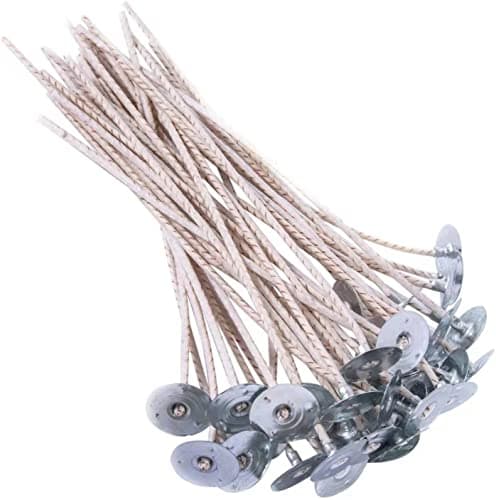 ECO 10 Pre-Waxed Wicks for Soy Candles, 100 pcsTop pickECO is the series whose charts are published for soy directly rather than adjusted from paraffin, which makes it the easiest series for a beginner to size correctly on the first try. | 3 to 3.25 inch soy containers, on the US charts | |
| 2 | 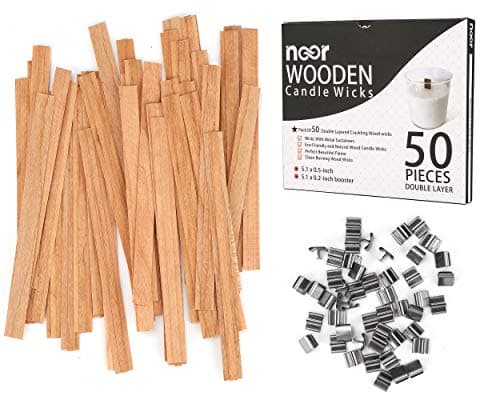 NOOR Double Layer Crackling Wood Wicks with Clips, 50 packThis is the booster construction the wooden wick charts keep referring to: a wide base ribbon bonded to a narrower one. It exists precisely because single-ply wooden wicks underperform in soy. | Wooden wicks in soy, where a single ribbon is not enough | |
| 3 | 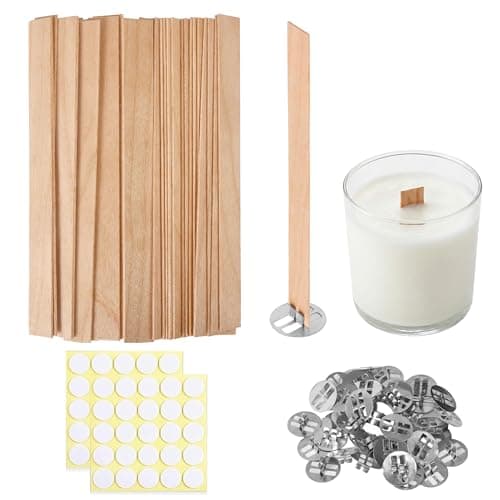 150 Piece Thickened Wooden Candle Wicks, 5.1 x 0.5 inchWooden wicks are bought for the sound, and they are the single hardest wick to size correctly in soy. The published charts disagree with each other by a full size on exactly this question. | The crackle, in a 2.5 to 3 inch jar | |
| 4 | 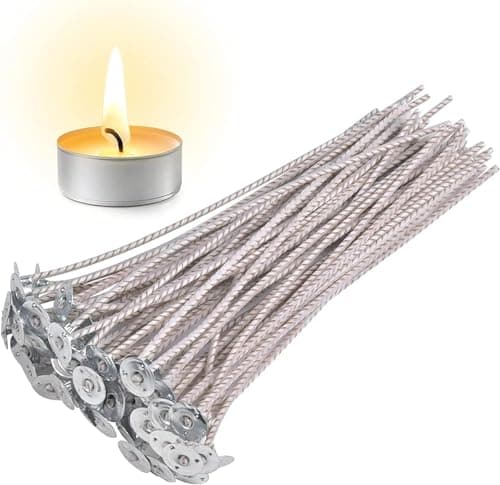 CD 12 Pre-Tabbed Candle Wicks for Soy Candles, 100 pcsCD 12 is the size the published soy charts point to for a standard 3-inch jar, which is the jar most beginner kits ship. Buying the series by size rather than by assortment is how you actually control a burn. | Jars around 2.5 to 3 inches across |
This comparison usually gets written as a matter of taste, and it is not. There is a genuine, checkable difference in how much published guidance exists for each, and that difference is the main thing a beginner should weigh.
| Cotton (ECO, CD) | Wooden | |
|---|---|---|
| Published sizing charts | Four, and they broadly agree | Two, and they disagree by a full size in soy |
| Sizing in soy | Specific to a quarter inch of diameter | Marginal above about 2.5 in without a booster |
| Sound | Silent | Crackle, which is the whole reason to buy them |
| Fragrance tolerance | Handles a 10 percent load | Smothers at high loads more readily |
| Flame shape | Round, roughly 1 to 1.5 in | Wide and low, follows the ribbon |
| Hardware | Standard wick tab, pre-tabbed | Dedicated clip, not interchangeable |
| Cost per wick | Lowest | Two to four times cotton |
| Attempts to get right | Usually one or two | Usually several |
Why wooden wicks are harder in soy
A wooden wick does not draw wax the way a braided cotton wick does. Cotton pulls liquid wax up through capillary action along the braid; wood burns along a ribbon, fed from the melt pool at its base. That difference is why wood is sensitive to melt pool depth in a way cotton is not.
Soy has a low melt point, typically in the 113 to 120F range for container blends, which means the melt pool forms readily but stays shallow and cool. A wooden wick in a shallow, cool pool can literally drown: the ribbon soaks, the flame drops, and it goes out. That is why Tools for Makers publishes the caution that pure soy usually needs a booster or double-ply wooden wick, and why Lone Star caps a medium wooden wick at 2.25 inches in soy but allows 3 inches in paraffin.
Why cotton is the default recommendation here
Not because it is better. Because it is *predictable*. Four publishers print ECO and CD charts, three of them agree to within a size, and the fourth disagrees in a documented, explainable direction. That means a beginner can measure a jar, read a chart, buy a wick and have a reasonable chance of a good candle on the first pour.
With wood, the published guidance for soy conflicts, and the honest advice is to buy a pack, burn several, and expect to change something. That is a fine hobby project and a poor first project.
The scent throw question
Wooden wicks are often sold on the claim that they throw scent better because the melt pool forms faster. We are not going to assert that, because we have not burned them and we have not found a published measurement of it. What is documented is the other direction: wooden wicks are more easily smothered by a heavy fragrance load, which is the opposite problem.
If scent throw is your goal, the levers with actual published numbers behind them are fragrance load, cure time and wax choice. Wick material is far down that list.
Top pick · 3 to 3.25 inch soy containers, on the US charts
ECO 10 Pre-Waxed Wicks for Soy Candles, 100 pcs
ECO series
ECO is the series whose charts are published for soy directly rather than adjusted from paraffin, which makes it the easiest series for a beginner to size correctly on the first try.
#ad · how this is funded · price as of October 17, 2026
Published specifications
- Series
- ECO, flat coreless cotton with paper filamentsSource: Amazon product listing, read 2026-09-02
- Quantity
- 100 piecesSource: Amazon product listing, read 2026-09-02
- Length
- 6 inches, pre-waxed with tabSource: Amazon product listing, read 2026-09-02
- Published range (soy)
- 3.0 to 3.25 inch containersSource: Lone Star Candle Supply ECO soy chart
- Alternative published range
- up to 2.76 inchesSource: Wedo metric ECO chart
What that means
The two published ranges above disagree by nearly half an inch for the same wick, and both are printed by people who sell it. That is not an error on anyone's part; the US charts are soy-adjusted and the Wedo chart covers soy and paraffin together.
Practically: if you are in a 3-inch soy jar and you use the US charts, ECO 10 is the starting wick. If you use Wedo's, you want ECO 14 in the same jar. Test both.
The paper filaments in an ECO wick make it curl and self-trim, in the same way CD does. Both are coreless, so there is no metal or zinc in the flame.
Good
- Charts published for soy directly, not adjusted from paraffin
- Coreless and self-trimming
- The series most commonly stocked with soy kits
Less good
- Published guidance varies by up to two sizes between suppliers
- Needs a size up again in beeswax
Skip this one if
You are burning paraffin. The LX and zinc charts are the ones written for it, and an ECO sized for soy will be too large.
Pick 2 · Wooden wicks in soy, where a single ribbon is not enough
NOOR Double Layer Crackling Wood Wicks with Clips, 50 pack
NOOR
This is the booster construction the wooden wick charts keep referring to: a wide base ribbon bonded to a narrower one. It exists precisely because single-ply wooden wicks underperform in soy.
#ad · how this is funded · price as of October 17, 2026
Published specifications
- Construction
- Double layer - 5.1 x 0.5 inch base bonded to a 5.1 x 0.2 inch boosterSource: Amazon product listing, read 2026-09-02
- Quantity
- 50 packSource: Amazon product listing, read 2026-09-02
- Clips
- IncludedSource: Amazon product listing, read 2026-09-02
- Why boosters exist
- Published guidance states pure soy usually requires a booster or double-ply wooden wickSource: Tools for Makers wooden wick chart
What that means
The booster is a second, narrower ribbon glued to the first. It gives the flame more fuel surface without widening the visible wick, which is the whole problem with wooden wicks in a low-melt wax.
If you tried a single wooden wick in soy and it drowned in its own melt pool, this is the fix the charts are pointing at.
Good
- Addresses the documented soy weakness of single-ply wooden wicks
- Clips included, which single-ribbon packs often omit
- Louder crackle than a single ply
Less good
- Fewer per pack than the single-ply option
- Still needs a burn test
- Overkill in paraffin
Skip this one if
You are burning paraffin, where a single-ply wooden wick already has enough draw.
Pick 3 · The crackle, in a 2.5 to 3 inch jar
150 Piece Thickened Wooden Candle Wicks, 5.1 x 0.5 inch
Generic (Amazon listing)
Wooden wicks are bought for the sound, and they are the single hardest wick to size correctly in soy. The published charts disagree with each other by a full size on exactly this question.
#ad · how this is funded · price as of October 17, 2026
Published specifications
- Dimensions
- 5.1 x 0.5 x 0.06 inchesSource: Amazon product listing, read 2026-09-02
- Quantity
- 150 piecesSource: Amazon product listing, read 2026-09-02
- Published range, 0.5 inch ribbon
- 2.5 to 3 inch containers, soy or paraffinSource: Tools for Makers wooden wick chart
- Conflicting published guidance
- Medium wooden wick rated to 2.25 inches in soy, 3.0 inches in paraffinSource: Lone Star Candle Supply wooden wick chart
What that means
Those two published figures cannot both be right for the same jar. One chart puts a half-inch wooden ribbon at up to 3 inches in soy; the other caps a comparable medium wick at 2.25 inches in soy and only allows 3 inches in paraffin.
The practical read: in pure soy, a wooden wick is likely to struggle in anything wider than about 2.5 inches without a booster. Buy the wick, but expect a burn test, and expect to need a second one.
Wooden wicks are also the wick most sensitive to fragrance load. A heavy oil load smothers them in a way it does not smother cotton.
Good
- The crackle, which no cotton wick produces
- 150 in a pack, which you will need for testing
- Dimensions published exactly
Less good
- Published sizing guidance conflicts by a full size in soy
- Struggles at high fragrance loads
- Needs a dedicated clip, not a standard wick tab
Skip this one if
You want a candle that works on the first pour. Wooden wicks in soy are the most test-hungry combination in this whole category.
Pick 4 · Jars around 2.5 to 3 inches across
CD 12 Pre-Tabbed Candle Wicks for Soy Candles, 100 pcs
CD series
CD 12 is the size the published soy charts point to for a standard 3-inch jar, which is the jar most beginner kits ship. Buying the series by size rather than by assortment is how you actually control a burn.
#ad · how this is funded · price as of October 17, 2026
Published specifications
- Series
- CD, cotton and paper flat braidSource: Amazon product listing, read 2026-09-02
- Quantity
- 100 piecesSource: Amazon product listing, read 2026-09-02
- Length
- 6 inches, pre-tabbedSource: Amazon product listing, read 2026-09-02
- Published range (soy)
- 2.5 to 3 inch containersSource: Tools for Makers CD soy chart
What that means
CD wicks curl as they burn, which trims the tip and reduces the mushroom of carbon that builds on a straight wick. That self-trimming behavior is the whole reason the series exists.
The published charts disagree on CD for soy by up to two sizes, because Lone Star prints CD against base paraffin and tells you to size up one to three for soy. Our chart shows both readings side by side.
Good
- One size, 100 of them, so you can run a proper burn test
- Self-trimming curl reduces mushrooming
- Pre-tabbed, so no assembly
Less good
- Wrong size for a 4-inch jar and wrong size for a votive
- CD in beeswax needs a different size again
Skip this one if
You do not yet know your container diameter. Measure the inside of the jar first, then buy the size the chart gives you.
Which to buy
- First candle ever: cotton, sized from the chart. Get one working candle before adding variables.
- You want the crackle: wooden, double-ply, in a container no wider than 3 inches, and buy enough to test.
- Gift candles at volume: cotton. Consistency across a batch matters more than the sound.
- Paraffin: either. Wood is much better behaved in paraffin, where the charts actually agree.
How these picks were made. Published specifications compiled from the sources listed below, the arithmetic shown on the page, and live Amazon prices. No product here has been burned by us. Read the method.
Common questions
Are wooden wicks better for soy candles?
The published charts suggest the opposite. Lone Star caps a medium wooden wick at 2.25 inches in soy against 3 inches in paraffin, and Tools for Makers notes that pure soy usually needs a booster or double-ply wooden wick. Wood is easier to get right in paraffin.
Do wooden wicks really crackle?
Yes, and it is the main reason to buy them. The sound comes from moisture and wax vaporizing in the wood grain. Double-ply booster wicks generally produce a louder crackle than single ribbons.
Can I use a wooden wick with a regular wick tab?
No. Wooden wicks need a dedicated clip that grips the ribbon. Cotton tabs crimp onto a braided wick and will not hold a flat ribbon.
Which wick burns longer?
Burn time is set by the wax volume and the melt rate, not by the wick material. A correctly sized wick of either type will consume the candle at roughly the same rate. An oversized wick of either type burns it faster.
Sources
Read next

Wicks and Wick Sizing
Four published sizing charts cross-referenced into one table, plus the wick picks that match the containers most kits ship.
Candle Wick Size Chart
ECO, CD, HTP, LX, zinc and wooden wick sizes from four published charts, cross-referenced by container diameter with every publisher named.
Best Candle Wicks for Soy Candles
Wick picks matched to the container sizes most kits ship, with the published chart range printed on every one.
Top pick
ECO 10 Pre-Waxed Wicks for Soy Candles, 100 pcs
CD vs ECO vs HTP Wicks
The CD, ECO, HTP and LX series compared by construction, published basis wax and sizing, with the equivalent sizes for a 3-inch jar.
How to Increase Scent Throw
The five levers on scent throw - melt pool, load, addition temperature, cure and wax - ordered by cost, with published figures.
Best Wood Wicks for Candle Making
Wooden wicks ranked on published ribbon width, thickness and container range, with the two published wood charts and the sellers' narrower claims side by side.
Top pick
NOOR Double Layer Crackling Wood Wicks with Clips, 50 pack