Wicks and Wick Sizing
CD vs ECO vs HTP Wicks
Four letter codes, four different charts, and one question: which chart applies to the wax in your pot.
We have not burned these candles and we do not claim to have. Here is what we did instead. Links to Amazon earn us a commission at no extra cost to you — disclosure.

| # | Product | Best for | Price |
|---|---|---|---|
| 1 | 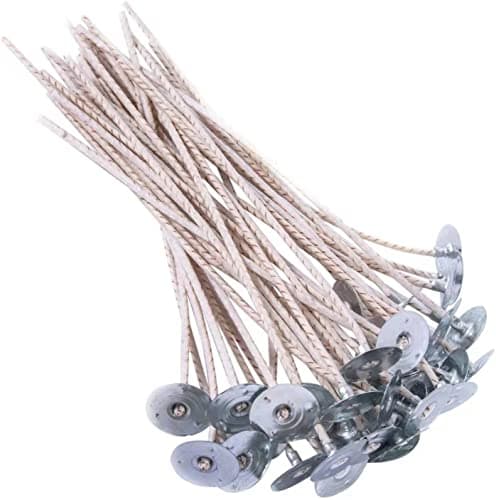 ECO 10 Pre-Waxed Wicks for Soy Candles, 100 pcsTop pickECO is the series whose charts are published for soy directly rather than adjusted from paraffin, which makes it the easiest series for a beginner to size correctly on the first try. | 3 to 3.25 inch soy containers, on the US charts | |
| 2 | 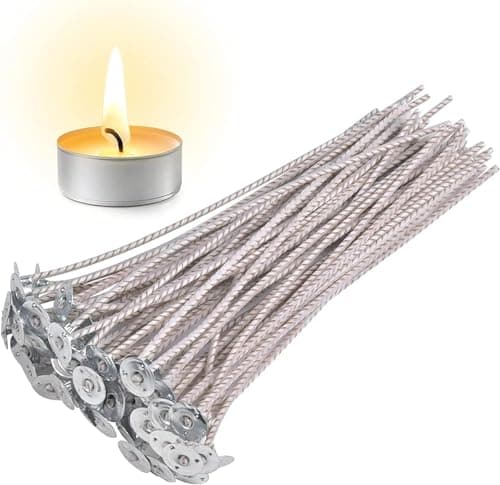 CD 12 Pre-Tabbed Candle Wicks for Soy Candles, 100 pcsCD 12 is the size the published soy charts point to for a standard 3-inch jar, which is the jar most beginner kits ship. Buying the series by size rather than by assortment is how you actually control a burn. | Jars around 2.5 to 3 inches across | |
| 3 | 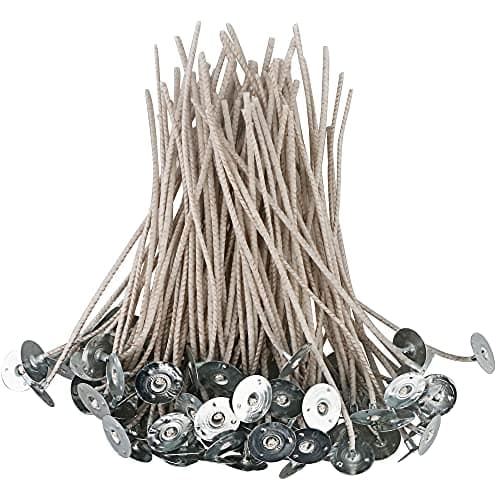 CD 10 Pre-Tabbed Candle Wicks for Soy Candles, 100 pcsOne size down from CD 12, for the smaller jars and tins that most kits also include. Having both on the shelf is what lets you fix a tunneling candle without waiting for a delivery. | Jars around 2.25 to 2.75 inches across | |
| 4 | 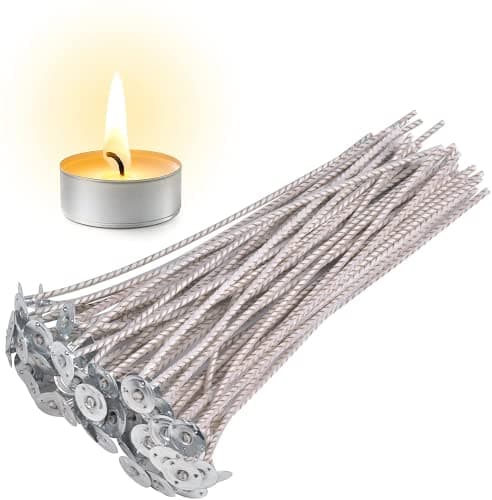 ECO 4 Pre-Waxed Wicks for Soy Candles, 100 pcsThe size for the 4-ounce tins that come in nearly every starter kit. Kits routinely ship one unnamed wick size for every container they include, and this is what those small tins actually wanted. | Small tins and 2 to 2.5 inch jars |
The series codes are not sizes and they are not grades. Each one is a different braid construction from a different maker, and each comes with its own chart calibrated against a particular wax. Buying the right series matters less than knowing which chart applies to it.
| Series | Construction | Chart is published for | Self-trimming |
|---|---|---|---|
| ECO | Flat coreless cotton with paper filaments | Soy, directly (Lone Star, CandleScience, Tools for Makers) | Yes, curls as it burns |
| CD | Flat coreless cotton and paper braid | Soy on the Tools for Makers chart; base paraffin on Lone Star's | Yes, curls as it burns |
| HTP | Cotton with paper filaments, higher tension | Base paraffin, size up one to three for soy | Partially |
| LX | Flat braided cotton with stability threads | Base paraffin | Controlled curl |
ECO and CD are close cousins
Both are coreless flat braids with paper filaments woven in, and both curl as they burn so the tip is consumed rather than accumulating carbon. In practice they behave similarly enough that most makers pick one and stay with it.
The practical reason to prefer ECO for a first candle is that its charts are published against soy directly. Lone Star's ECO chart carries a note that it already accounts for soy sizing, with no size-up instruction attached. That removes a step, and it removes the step where beginners most often go wrong.
HTP and LX are paraffin series
You will still see them recommended for soy, and they do work, but every published HTP and LX chart we found is printed against base paraffin with an instruction to size up one to three for soy. That is a wide instruction. Sizing up one from HTP-73 gives HTP-83; sizing up three gives HTP-105. Those are very different candles.
If you are working in paraffin, this reverses completely: LX and HTP charts are the ones written for your wax, and an ECO sized from a soy chart will be too large.
The same jar, in every series
| Series | Soy | Paraffin | Published by |
|---|---|---|---|
| ECO | ECO 10 | not the series for it | Lone Star, CandleScience, Tools for Makers |
| ECO (maker's metric chart) | ECO 14 | ECO 14 | Wedo, metric chart |
| CD | CD 14 to CD 16 | CD-10 | Tools for Makers (soy), Lone Star (paraffin) |
| HTP | HTP-83 to HTP-105 after sizing up | HTP-73 | Lone Star |
| LX | LX-18 to LX-22 after sizing up | LX-16 to LX-18 | Lone Star |
What about zinc core
Zinc-cored wicks have a metal wire through the braid that holds them upright in liquid wax. Lone Star publishes zinc sizes against base paraffin and states plainly that they are not recommended for soy. They are still common in tealights and votives, where the rigidity earns its place.
The zinc chart also has a documented gap: it jumps from a 2.0 to 2.25 inch row straight to a 3.0 to 3.5 inch row with nothing between. We reproduce that gap in the chart rather than filling it in, because filling it in would be inventing data.
Top pick · 3 to 3.25 inch soy containers, on the US charts
ECO 10 Pre-Waxed Wicks for Soy Candles, 100 pcs
ECO series
ECO is the series whose charts are published for soy directly rather than adjusted from paraffin, which makes it the easiest series for a beginner to size correctly on the first try.
#ad · how this is funded · price as of October 17, 2026
Published specifications
- Series
- ECO, flat coreless cotton with paper filamentsSource: Amazon product listing, read 2026-09-02
- Quantity
- 100 piecesSource: Amazon product listing, read 2026-09-02
- Length
- 6 inches, pre-waxed with tabSource: Amazon product listing, read 2026-09-02
- Published range (soy)
- 3.0 to 3.25 inch containersSource: Lone Star Candle Supply ECO soy chart
- Alternative published range
- up to 2.76 inchesSource: Wedo metric ECO chart
What that means
The two published ranges above disagree by nearly half an inch for the same wick, and both are printed by people who sell it. That is not an error on anyone's part; the US charts are soy-adjusted and the Wedo chart covers soy and paraffin together.
Practically: if you are in a 3-inch soy jar and you use the US charts, ECO 10 is the starting wick. If you use Wedo's, you want ECO 14 in the same jar. Test both.
The paper filaments in an ECO wick make it curl and self-trim, in the same way CD does. Both are coreless, so there is no metal or zinc in the flame.
Good
- Charts published for soy directly, not adjusted from paraffin
- Coreless and self-trimming
- The series most commonly stocked with soy kits
Less good
- Published guidance varies by up to two sizes between suppliers
- Needs a size up again in beeswax
Skip this one if
You are burning paraffin. The LX and zinc charts are the ones written for it, and an ECO sized for soy will be too large.
Pick 2 · Jars around 2.5 to 3 inches across
CD 12 Pre-Tabbed Candle Wicks for Soy Candles, 100 pcs
CD series
CD 12 is the size the published soy charts point to for a standard 3-inch jar, which is the jar most beginner kits ship. Buying the series by size rather than by assortment is how you actually control a burn.
#ad · how this is funded · price as of October 17, 2026
Published specifications
- Series
- CD, cotton and paper flat braidSource: Amazon product listing, read 2026-09-02
- Quantity
- 100 piecesSource: Amazon product listing, read 2026-09-02
- Length
- 6 inches, pre-tabbedSource: Amazon product listing, read 2026-09-02
- Published range (soy)
- 2.5 to 3 inch containersSource: Tools for Makers CD soy chart
What that means
CD wicks curl as they burn, which trims the tip and reduces the mushroom of carbon that builds on a straight wick. That self-trimming behavior is the whole reason the series exists.
The published charts disagree on CD for soy by up to two sizes, because Lone Star prints CD against base paraffin and tells you to size up one to three for soy. Our chart shows both readings side by side.
Good
- One size, 100 of them, so you can run a proper burn test
- Self-trimming curl reduces mushrooming
- Pre-tabbed, so no assembly
Less good
- Wrong size for a 4-inch jar and wrong size for a votive
- CD in beeswax needs a different size again
Skip this one if
You do not yet know your container diameter. Measure the inside of the jar first, then buy the size the chart gives you.
Pick 3 · Jars around 2.25 to 2.75 inches across
CD 10 Pre-Tabbed Candle Wicks for Soy Candles, 100 pcs
CD series
One size down from CD 12, for the smaller jars and tins that most kits also include. Having both on the shelf is what lets you fix a tunneling candle without waiting for a delivery.
#ad · how this is funded · price as of October 17, 2026
Published specifications
- Series
- CD, cotton and paper flat braidSource: Amazon product listing, read 2026-09-02
- Quantity
- 100 piecesSource: Amazon product listing, read 2026-09-02
- Length
- 6 inches, pre-tabbedSource: Amazon product listing, read 2026-09-02
- Published range (soy)
- 2.25 to 2.75 inch containersSource: Tools for Makers CD soy chart
What that means
The gap between CD 10 and CD 12 is roughly a quarter of an inch of container diameter. That sounds trivial and is not: a quarter inch is the difference between a full melt pool and a tunnel.
Buy the size below and the size above your target. Burn testing means comparing, and you cannot compare with one size in the drawer.
Good
- Covers the small-jar range most kits ship
- Same self-trimming behavior as CD 12
- Pre-tabbed
Less good
- Too small for a standard 3-inch jar in soy
- Single size, so no comparison in one purchase
Skip this one if
Your jars are 3 inches or wider. This wick will tunnel and you will blame the wax.
Pick 4 · Small tins and 2 to 2.5 inch jars
ECO 4 Pre-Waxed Wicks for Soy Candles, 100 pcs
ECO series
The size for the 4-ounce tins that come in nearly every starter kit. Kits routinely ship one unnamed wick size for every container they include, and this is what those small tins actually wanted.
#ad · how this is funded · price as of October 17, 2026
Published specifications
- Series
- ECO, flat coreless cotton with paper filamentsSource: Amazon product listing, read 2026-09-02
- Quantity
- 100 piecesSource: Amazon product listing, read 2026-09-02
- Published range (soy)
- 2.0 to 2.5 inch containersSource: Lone Star Candle Supply ECO soy chart
What that means
A standard 4-ounce candle tin measures a little under 2.5 inches across the inside. That puts it squarely in the ECO 4 row on both US charts.
Small containers are where an oversized wick shows up fastest: the flame is large relative to the vessel, the glass gets hot, and the candle burns down in an evening.
Good
- Correct size for the ubiquitous 4-ounce tin
- Coreless
- 100 in a pack, enough for real testing
Less good
- Far too small for a standard 3-inch jar
- One size only
Skip this one if
Your containers are 3 inches or wider. Start at ECO 10 instead.
Which series to buy
- Soy container candles: ECO first, CD second. Both have soy-specific charts and both self-trim.
- Paraffin container candles: LX or HTP, sized from the base-paraffin charts with no adjustment, and the packs themselves are ranked in best wicks for paraffin candles.
- Beeswax: ECO, sized up one to two from the soy row per the Tools for Makers note. The beeswax chart works that derivation out for every diameter.
- Coconut soy blends: start from the soy ECO row and expect to go down a size, because the lower melt point delivers wax more freely.
How these picks were made. Published specifications compiled from the sources listed below, the arithmetic shown on the page, and live Amazon prices. No product here has been burned by us. Read the method.
Common questions
Is CD or ECO better for soy candles?
Both work. ECO has the small advantage that its charts are published against soy directly, with no size-up step, which removes the place beginners most often go wrong. CD is more widely stocked.
Can I use HTP wicks in soy wax?
Yes, but the published HTP charts are calibrated for base paraffin and instruct you to size up one to three for soy. That is a wide range, so expect to burn-test rather than trusting the first size.
Does ECO 10 equal CD 10?
No. The numbers are internal to each series and do not correspond. For a 3-inch soy jar the published answers are ECO 10 and CD 14 to CD 16.
Why are zinc wicks not recommended for soy?
Lone Star publishes them as not recommended for soy. Zinc-cored wicks were developed for paraffin's higher melt point and stiffer pool; in soy they tend to run hot and mushroom.
Sources
Read next
Wicks and Wick Sizing
Four published sizing charts cross-referenced into one table, plus the wick picks that match the containers most kits ship.
Candle Wick Size Chart
ECO, CD, HTP, LX, zinc and wooden wick sizes from four published charts, cross-referenced by container diameter with every publisher named.

Best Candle Wicks for Soy Candles
Wick picks matched to the container sizes most kits ship, with the published chart range printed on every one.
Top pick
ECO 10 Pre-Waxed Wicks for Soy Candles, 100 pcs
Cotton vs Wood Wicks
Cotton and wooden wicks compared on sizing certainty, burn behavior, fragrance tolerance and cost, with picks for each.
Candle Wax Types Explained
Every candle wax type explained: the four families, container against pillar formulation, blends, additives and grades.