Fragrance and Scent Throw
Fragrance Oil vs Essential Oil
One of these is what commercial candles use, and the reason is not that it is cheaper.
We have not burned these candles and we do not claim to have. Here is what we did instead. Links to Amazon earn us a commission at no extra cost to you — disclosure.
| # | Product | Best for | Price |
|---|---|---|---|
| 1 | 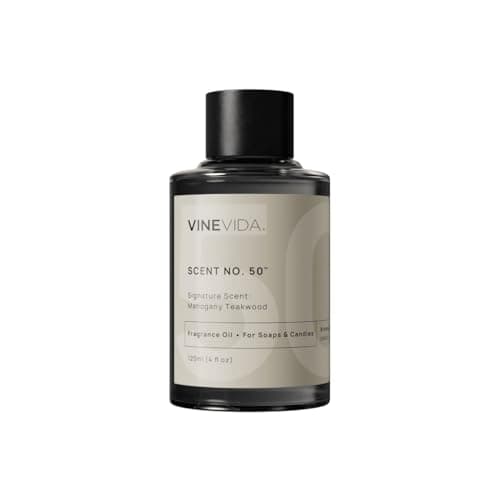 VINEVIDA Mahogany Teakwood Fragrance Oil, 4 ozTop pickMahogany Teakwood is the most-copied candle scent in the US market for a reason: it is a heavy woody-amber that holds up at high load and does not fade over a cure. Four ounces is enough for a real batch. | One scent, in enough quantity to make a batch | |
| 2 | 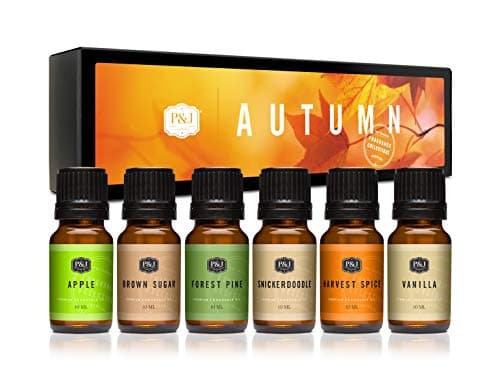 P&J Fragrance Oil Autumn Set, 6 scentsSix named autumn scents rather than six unnamed bottles. Being able to re-order the one that worked, by name, is the difference between a hobby and a lucky accident. | The holiday season the site's readers are actually buying for | |
| 3 | 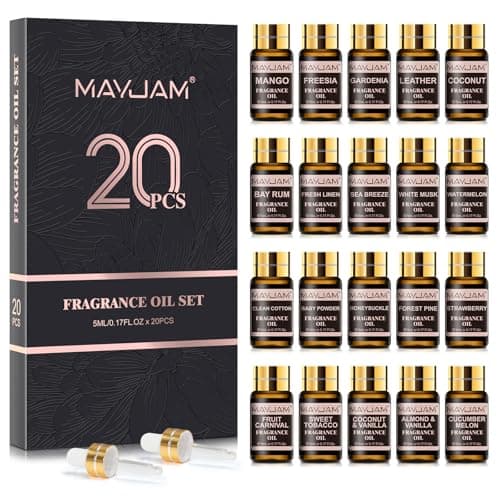 MAYJAM Essential Oils Set for Diffusers, Soap and Candle MakingIncluded here as the honest comparison, not as a recommendation for candles. Essential oils are what people reach for when they want a natural candle, and they are the reason those candles smell like nothing when lit. | Understanding why essential oils underperform in wax |
This comparison is usually framed as natural against synthetic, which makes it a values question. It is more useful as a physics question, because the physics explains both the throw difference and the cost difference, and it tells you which essential oils are worth trying.
What each one is
- Essential oil. A plant distillate. Steam or pressure extracts the volatile aromatic compounds from a plant, and what you have is those compounds and very little else.
- Fragrance oil. A formulated blend, usually of synthetic aroma chemicals and often some natural isolates, designed and tested for a particular application - in this case, dissolving into hot wax and releasing gradually from a melt pool.
The word volatile in the first definition is the whole story. Volatility is what makes an essential oil smell strongly when you open the bottle, and it is what makes it disappear from a candle.
The comparison
| Fragrance oil | Essential oil | |
|---|---|---|
| Hot throw | Strong | Weak to moderate |
| Survives the pour at 170F | Formulated to | Lighter notes flash off |
| Survives a two-week cure | Yes | Partially |
| Cost per ounce | Low to moderate | High to very high |
| Scent range | Almost unlimited, including impossible ones | Limited to what plants produce |
| Natural | No, mostly synthetic | Yes |
| Consistency batch to batch | High | Varies with harvest |
| Flash point published | Usually, by good suppliers | Often not |
Why the throw is weaker, precisely
Three losses stack up. First, the pour: at 170F a large fraction of an essential oil's lightest compounds volatilize immediately and are gone. Second, the cure: over one to two weeks at room temperature, more of them continue to leave. Third, the burn: what remains has to survive hours at melt pool temperature.
A fragrance oil is formulated with those three losses in mind, using heavier fixative molecules that stay put. An essential oil was distilled from a plant and is not formulated for anything.
Making essential oils work
- Choose heavy oils. Patchouli, cedarwood, vetiver, clove, cinnamon leaf, sandalwood. These are base notes and they behave in wax more like a fragrance oil does.
- Avoid citrus. Lemon, orange, grapefruit and bergamot are the most volatile essential oils there are. In a candle they are close to a waste of money.
- Run at the top of the wax maximum. Golden Wax 464 publishes 10 percent, and essential oils need every bit of that.
- Add at the lower end of the addition range. The published GW 464 figure is 170F; a few degrees lower loses less of the light material, at some cost to how well it binds.
- Cure longer. Three weeks rather than two.
- Blend with a heavy base. A little patchouli or cedarwood under a lighter oil holds the whole blend together, which is exactly what perfumers do.
Top pick · One scent, in enough quantity to make a batch
VINEVIDA Mahogany Teakwood Fragrance Oil, 4 oz
VINEVIDA
Mahogany Teakwood is the most-copied candle scent in the US market for a reason: it is a heavy woody-amber that holds up at high load and does not fade over a cure. Four ounces is enough for a real batch.
#ad · how this is funded · price as of October 17, 2026
Published specifications
- Size
- 4 ozSource: Amazon product listing, read 2026-09-02
- Intended uses
- Candle making, soap making, perfume oilsSource: Amazon product listing, read 2026-09-02
- Recommended load
- Not published on the listing
What that means
Four ounces of fragrance at an 8 percent load scents about 50 ounces of wax, which is roughly six 8-ounce candles. A sampler bottle does not get you a batch; this does.
Woody-amber fragrances are the most forgiving family in wax. They carry through the cure, they survive a high pour temperature, and they do not discolor soy the way vanilla does.
Good
- Enough volume to make a consistent batch
- A fragrance family that holds up in soy
- Single named scent, so results are reproducible
Less good
- One scent only
- No published flash point or IFRA maximum on the listing
Skip this one if
You do not yet know which scents you like. Buy a six-bottle sampler first and come back for the winner.
Pick 2 · The holiday season the site's readers are actually buying for
P&J Fragrance Oil Autumn Set, 6 scents
P&J Trading
Six named autumn scents rather than six unnamed bottles. Being able to re-order the one that worked, by name, is the difference between a hobby and a lucky accident.
#ad · how this is funded · price as of October 17, 2026
Published specifications
- Scents included
- Brown Sugar, Apple, Harvest Spice, Vanilla, Forest Pine, SnickerdoodleSource: Amazon product listing, read 2026-09-02
- Count
- 6 bottlesSource: Amazon product listing, read 2026-09-02
- Intended uses
- Candle making, soap making, diffusersSource: Amazon product listing, read 2026-09-02
- Flash point
- Listing prints only Flash Points greater than 200, with no unitSource: Amazon Creators API item data, read 2026-09-26
- Composition claims
- Phthalate-free and cruelty-free, sourced and manufactured in the USASource: Amazon Creators API item data, read 2026-09-26
- Formulated by
- Stated as IFRA certified master perfumersSource: Amazon Creators API item data, read 2026-09-26
- Recommended load
- Not published on the listing
What that means
Named scents matter more than they look. Kit fragrance oils are usually unlabeled, so when one of your candles turns out well you have no way to make it again.
The listing does not publish a recommended fragrance load, so use the wax maker's figure instead. Golden Wax 464 publishes a 10 percent maximum, and most makers land between 6 and 8 percent.
Forest Pine and Harvest Spice are the two that hold up at a high load. Vanilla in soy tends to discolor the wax to a cream over a few weeks, which is a cosmetic issue rather than a fault.
Good
- Six named, re-orderable scents
- Season-appropriate range for gift candles
- Sold specifically for candle making rather than diffuser-only
Less good
- No published recommended load, though the flash point is stated
- Vanilla discolors soy over time
Skip this one if
You want one scent in quantity. A six-bottle sampler is the wrong purchase if you already know you want to make twelve of the same candle.
Pick 3 · Understanding why essential oils underperform in wax
MAYJAM Essential Oils Set for Diffusers, Soap and Candle Making
MAYJAM
Included here as the honest comparison, not as a recommendation for candles. Essential oils are what people reach for when they want a natural candle, and they are the reason those candles smell like nothing when lit.
$15.99 · 19% off
#ad · how this is funded · price as of October 17, 2026
Published specifications
- Type
- Essential oilsSource: Amazon product listing, read 2026-09-02
- Intended uses
- Diffuser, soap and candle makingSource: Amazon product listing, read 2026-09-02
- Flash point
- Not published on the listing
What that means
Essential oils are volatile plant distillates. In a diffuser, where nothing is burning, that volatility is the point. In a candle it means most of the aromatic compounds leave before they can scent a room.
You can make an essential oil candle work: use a high load, choose the heavier oils such as patchouli, cedarwood or clove, and accept a weaker throw than a fragrance oil would give.
We list this so that a reader who wants a natural candle knows what they are choosing, not because we think it is the better buy for scent throw.
Good
- Genuinely plant-derived
- Excellent in a diffuser
- The right answer if natural matters more than throw
Less good
- Substantially weaker scent throw in a burning candle than fragrance oil
- Costs more per ounce than fragrance oil
- No published flash point, which matters more for essential oils than fragrance oils
Skip this one if
Scent throw is your priority. This is the honest trade-off, and if throw is what you want, a fragrance oil wins clearly.
The cost
Essential oils cost several times what fragrance oils cost per ounce, and a candle needs them at a higher load to work. That compounds: an essential oil candle can cost several times what the same candle costs in fragrance oil, for less throw.
That is a fair trade if natural is the point. It is a bad trade if you were expecting a better candle.
Safety
Two practical notes. Never use perfume or an alcohol-based scent in a candle: alcohol is flammable and a candle is an open flame. And check whether your fragrance supplier publishes a flash point, because a very low flash point oil is a hazard when added to wax at 170F. Good fragrance oil suppliers publish this; essential oil listings often do not.
If you are making candles for people with pets, note also that several essential oils - tea tree and pine among them - are documented as problematic for cats. That is a reason to be careful with essential oils specifically, not a general argument against them. For the single scent where this argument is closest, best lavender fragrance oils for candles works the comparison through six real listings, including the cheapest essential oil per ounce we have found.
How these picks were made. Published specifications compiled from the sources listed below, the arithmetic shown on the page, and live Amazon prices. No product here has been burned by us. Read the method.
Common questions
Can you use essential oils in candles?
Yes, but expect a weaker throw than a fragrance oil gives. Essential oils are volatile plant distillates and much of the aromatic material leaves during the pour, the cure and the burn.
Which essential oils work best in candles?
The heavy base notes: patchouli, cedarwood, vetiver, clove, cinnamon leaf and sandalwood. Citrus oils are the worst performers because they are the most volatile.
Why do commercial candles use fragrance oil?
Because fragrance oils are formulated for the job: they survive being added to hot wax, they survive a cure, and they release gradually from a melt pool. Cost is a factor too, but performance is the main one.
Are fragrance oils safe in candles?
Fragrance oils sold for candle making are formulated for it. The safety points that matter are using a candle-specific oil rather than a diffuser-only one, staying within the wax's published maximum load, and never using an alcohol-based scent such as perfume.
How much essential oil per pound of wax?
Use the wax's published maximum, which for Golden Wax 464 is 10 percent by weight, or 1.6 ounces per pound. Essential oils need the top of that range to throw at all.
Sources
Read next
Fragrance and Scent Throw
Fragrance load, addition temperature, cure time and wax choice: the four levers that decide scent throw, with the published numbers for each.
Best Fragrance Oils for Candles
Candle fragrance oils ranked on named scents, quantity per bottle and how they behave in soy, with load arithmetic per size.
Top pick
P&J Fragrance Oil Autumn Set, 6 scents
How Much Fragrance Oil Per Pound of Wax
Fragrance load arithmetic: the formula, a table by batch size, the published maximum for GW 464, and why load is a weight percentage.

How to Increase Scent Throw
The five levers on scent throw - melt pool, load, addition temperature, cure and wax - ordered by cost, with published figures.
Candle Cure Time
How long to cure candles by wax type, what happens chemically during a cure, and how to store them while they do.
Best Essential Oils for Candles
Essential oils ranked for candle use on volume, published purity and how much of the scent survives a melt pool, with the fragrance oil comparison stated plainly.
Top pick
Handcraft Blends Peppermint Essential Oil, 4 fl oz